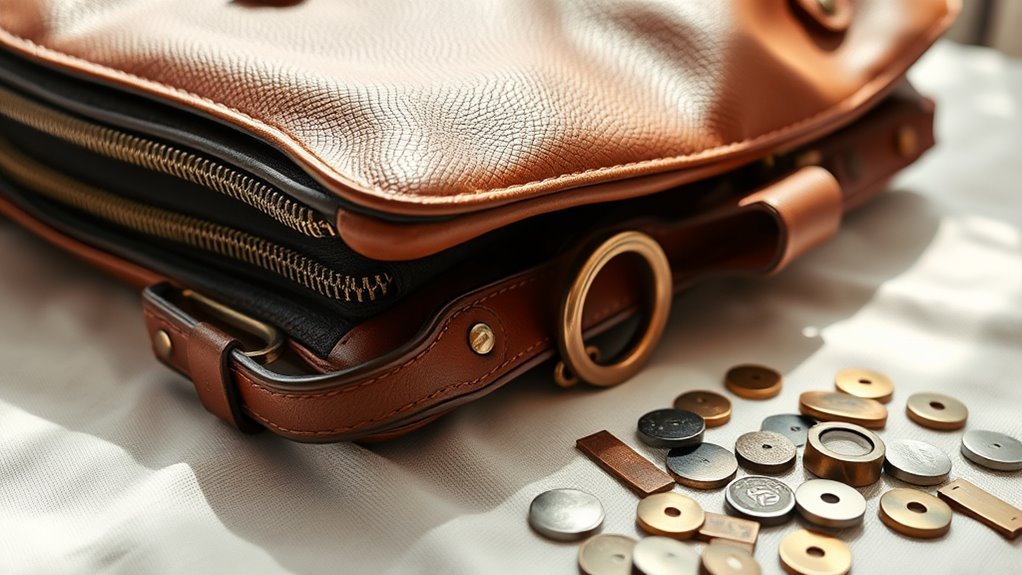
Your handbag hardware tarnishes when oxygen, moisture, pollutants, skin oils, perfumes, and friction attack its finish and expose the base metal. Electroplated layers wear unevenly, so zamak often shows white corrosion spots, while brass usually darkens into a protective patina. Humidity and temperature swings speed the process. You can slow it with dry wiping, breathable storage, and silica gel. PVD and thicker replating offer stronger resistance, and the next sections explain when each finish performs best.
Why Handbag Hardware Tarnishes
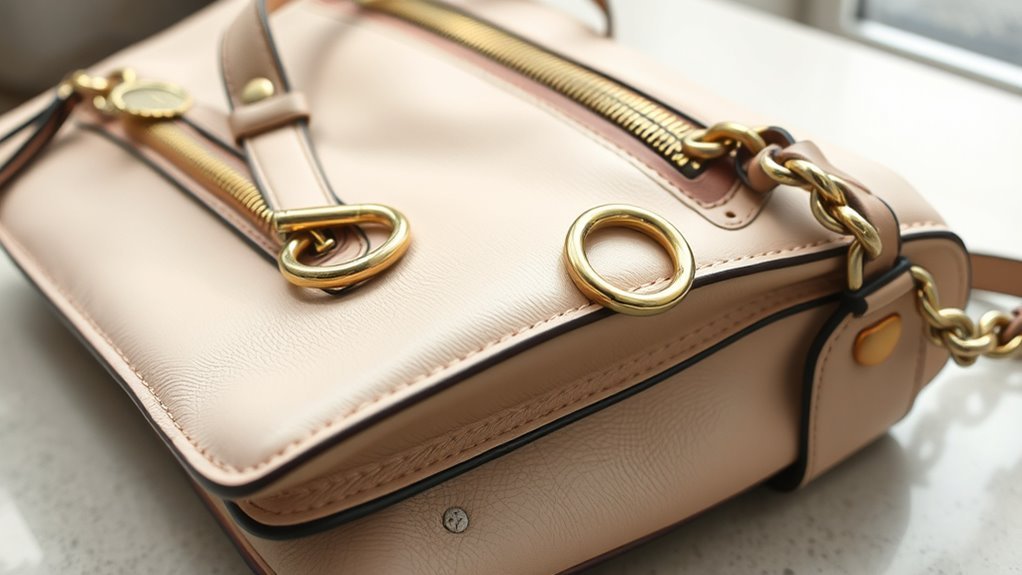
Handbag hardware tarnishes when the metal surface oxidizes, meaning it reacts with oxygen, moisture, and airborne pollutants to form discoloration and dullness.
You’ll see this process intensify when skin oils, perfumes, and cleaning chemicals contact the finish, because they disrupt protective layers and accelerate surface change.
Electroplated hardware can wear unevenly, exposing reactive base metal beneath. In humid or coastal air, temperature swings further drive corrosion, so your bag’s fittings lose their crisp sheen faster.
Zamak tarnishes readily and may show white powdery spots, while brass often darkens and can develop a patina.
Your best tarnish prevention starts with material selection: choose metals and coatings matched to your climate, wear habits, and maintenance capacity.
Then clean hardware regularly and store it dry, so you keep control over the object and refuse unnecessary degradation.
How Handbag Hardware Reacts to Air and Moisture
Air and moisture are the main drivers behind hardware tarnishing because metal surfaces oxidize when they meet oxygen, humidity, and condensation. You see this as dulling, spotting, and color shift across exposed hardware.
Poor air quality adds pollutants that intensify the reaction, while high humidity keeps microscopic water films on the surface and speeds corrosion.
If you handle clasps, chains, and other high-touch parts often, friction and skin oils can abrade the thin electroplated layer, so the base metal faces air sooner. That’s where tarnish gains ground.
You can reduce the rate by using disciplined moisture control: store bags in stable conditions around 40%–60% relative humidity, avoid sealed damp spaces, and keep hardware dry after wear.
With better environmental control, you limit oxidation, preserve finish integrity, and keep your accessories visibly free.
Why Zamak and Brass Age Differently
Zamak and brass age differently because their alloy chemistry and surface treatments respond to moisture in distinct ways. You’ll see zamak oxidation first because zinc-rich alloys rely on a thin electroplated skin, often 0.5–1.0 microns, that can’t block humidity for long.
Zamak and brass age differently: zinc-rich coatings fail sooner, while brass develops a protective patina.
Brass behaves differently: it forms a brass patina that slows further attack and can even improve the metal’s appearance.
- Zamak tends to show white powdery spots when its coating fails.
- Brass usually darkens in a controlled way, building a stable surface layer.
- In humid climates, brass keeps its integrity longer, while zamak deteriorates faster.
You can treat brass lightly and often recover it with gentle cleaning.
Zamak, by contrast, usually needs professional restoration once tarnish advances. That difference matters when you choose hardware that supports durability, autonomy, and long-term aesthetic control.
How Friction and Skin Contact Speed Up Tarnish
Even when brass or zamak starts with a stable finish, daily use can wear that protection down. You create friction factors every time you open a clasp, swing a chain, or slide hardware against fabric. Those micro-abrasions thin plating and expose reactive metal, so tarnish advances faster in high-contact zones. Skin effects add another layer: oils, sweat, and moisture transfer directly to the surface, and perfumes or lotions can leave residues that alter the chemistry.
| Contact source | Tarnish impact |
|---|---|
| Clasps | High wear |
| Chains | Constant abrasion |
| Palms | Oil transfer |
| Sweat | Moisture reaction |
| Lotion | Chemical residue |
You can see the pattern clearly: more contact means more oxidation potential, less finish stability, and faster dulling. If you want hardware that keeps its edge and stays expressive, understand that touch isn’t neutral. It’s an active agent that reshapes the surface over time.
Which Care Habits Help Handbag Hardware Last
A few consistent habits can slow tarnish and extend the life of handbag hardware. You can protect the finish with disciplined cleaning techniques and controlled storage solutions.
- Wipe each clasp, ring, and zipper pull with a soft, dry microfiber cloth after use. This removes salts, oils, and airborne contaminants before they bond to the metal.
- Keep handbags in breathable cotton dust bags, not sealed plastic, so humidity stays stable. Add silica gel packets to absorb excess moisture and hold storage conditions near 40% to 60%.
- Inspect hardware every few months. If you see early dulling or spotting, clean it promptly so oxidation doesn’t advance.
You should also minimize contact with perfumes, lotions, and hand sanitizers. Those chemicals can attack metal finishes and accelerate visible tarnish.
When PVD or Replating Makes Sense
If you expose handbag hardware to frequent contact or humid conditions, PVD makes sense because it gives you stronger scratch and tarnish resistance than standard plating.
If the hardware already shows severe oxidation, replating can restore the original finish, especially on zinc alloys like zamak where the protective layer has failed.
You should also compare plating thickness, since thicker electroplating or PVD usually gives you better wear resistance and longer service life.
PVD For High Wear
For high-wear handbag hardware, PVD coating usually makes more sense than standard electroplating because it delivers a harder, more scratch-resistant finish with better resistance to tarnish and corrosion.
You get clear PVD advantages when your bag’s clasps, zippers, and rings face constant friction. PVD applications suit pieces exposed to sweat, humidity, and daily handling.
- PVD durability: its 2.0–3.0 micron layer outperforms thinner plating.
- PVD versus electroplating: it bonds strongly, so you reduce flaking risk.
- Practical choice: you preserve both function and finish without chemical baths.
If you want hardware that stays liberated from premature wear, PVD gives you a technically stronger surface and a longer service life.
Replating For Severe Tarnish
When severe tarnish goes beyond surface discoloration and the original plating has worn through, replating becomes a practical repair option. You’re no longer treating a cosmetic film; you’re restoring a depleted barrier that’s letting oxygen attack the base metal.
Professional replating techniques strip the damaged layer, prepare the substrate, and apply a fresh metal coat, such as gold or nickel, to recover integrity and finish. The replating benefits are clear: you extend hardware life, regain visual consistency, and reduce further corrosion.
If you expect heavy handling or humid exposure, PVD can outperform standard plating by resisting scratches and tarnish. Still, when damage is already severe, prompt replating can preserve the handbag’s value and keep you from replacing hardware that can still serve you.
Choosing The Right Finish
Choosing the right finish depends on how the hardware will be used and what it’s exposed to. In your finish comparison, prioritize durability, repairability, and environmental impact.
- PVD: Choose it for high-contact hardware. It resists scratches and tarnish better than standard plating, so it works well in humid, coastal, or tropical conditions where liberation from constant upkeep matters.
- Replating: Use it when tarnish has already exposed base metal, especially on zamak. A professional can restore the surface after the thin electroplated layer fails.
- Thicker electroplating: Specify 2.0–3.0 microns if you want more resilience than 0.5–1.0 microns. For brass, you get natural tarnish resistance, but you’ll still need regular maintenance to preserve the finish.
Frequently Asked Questions
How to Get Rid of Tarnish on Bag Hardware?
You can remove tarnish with cleaning methods: wipe hardware using a microfiber cloth, then apply metal polish to the cloth and buff gently. For tarnish prevention tips, store bags dry, use dust bags, and avoid abrasives.
How Do I Fix Tarnished Metal?
You’ll fix tarnished metal by testing a gentle cleaning technique first, then applying metal polish to a cloth, not hardware, and buffing carefully. If the theory fails, protective coatings or professional replating can restore freedom.
What Metal Will Never Tarnish?
No metal is absolutely untarnishable, but you’ll get closest with stainless steel, platinum, or pure gold. Avoid copper alloys, choose gold plating carefully, and follow maintenance tips to preserve finish and resist oxidation longer.
Is Tarnish a Chemical Change?
Yes—tarnish is a chemical change: you’re seeing chemical reactions, especially oxidation processes, alter the metal’s surface composition. You can’t reverse it by wiping alone; you’ll need treatment or protection to stop further degradation.
Conclusion
You can’t stop handbag hardware from meeting air, moisture, and friction, but you can slow the damage. A polished clasp may gleam today, while a bare brass edge or zamak plate dulls tomorrow. That contrast matters: one finish resists corrosion, another yields to it. If you clean, dry, and store your bag well, you extend its life. When wear’s advanced, PVD or replating isn’t indulgence—it’s a measured repair.