Affiliate disclosure: AutoReviewNest may earn a commission from qualifying purchases made through product links on this page, at no extra cost to you.
Quick Answer
For the trailer’s original tires and wheels, use the recommended cold PSI on the trailer certification label or in the owner’s manual. If the tire size, load range, wheel, or valve hardware has changed, verify the correct pressure with the trailer and tire manufacturers. Do not exceed the pressure rating of the tire, wheel, or valve stem, and keep the loaded trailer within its tire, wheel, hub, axle, GAWR, and GVWR load limits.
Key Takeaways
- Check trailer tire pressure before driving or after the trailer has been parked for at least three hours.
- Use the trailer placard or owner’s manual first when the original tire-and-wheel configuration is still installed.
- The tire sidewall lists a load and pressure limit; its maximum cold PSI is not automatically the correct operating pressure for every trailer.
- Keep pressures the same across the same axle unless the trailer or tire manufacturer gives different instructions.
- Do not bleed air from hot tires simply because pressure rises after driving. Let them cool and recheck the cold pressure.
At a Glance
| Time Required | 5–10 minutes before each trip |
| Difficulty | Easy |
| Tools Needed | Accurate gauge rated above the trailer’s target PSI, suitable air compressor, valve caps, flashlight, and a tread-depth gauge if available |
| Pressure Reference | Trailer certification label or manual; exact tire-maker load table when the installed configuration requires one |
Why Proper Tire Pressure Is Critical for Safe Towing
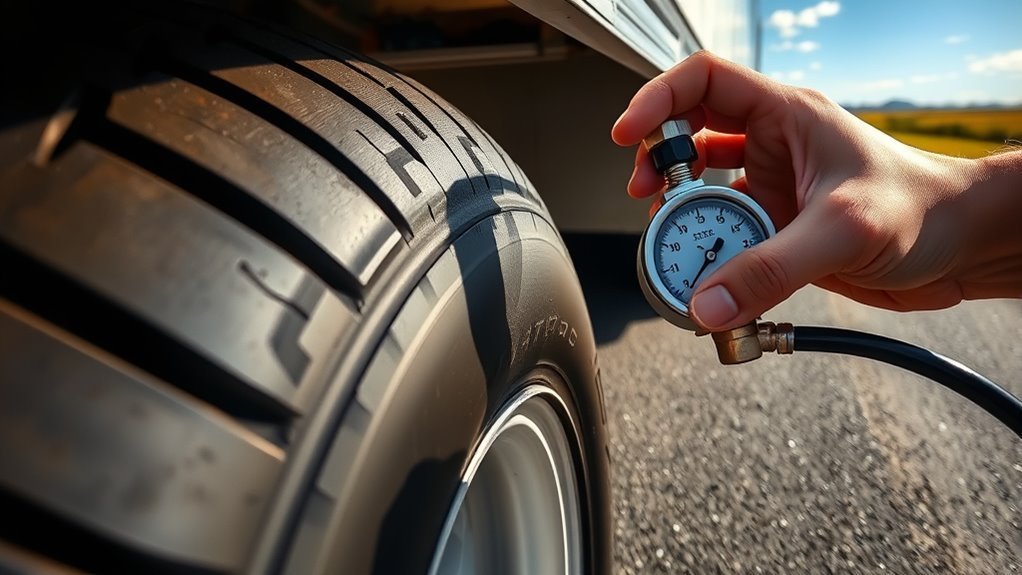
Each trailer tire carries part of the trailer’s loaded weight. If pressure is too low for that load, the sidewall flexes excessively, generating heat and internal stress. Overloading adds even more stress and can cause damage that is not visible from outside the tire.
The National Highway Traffic Safety Administration defines a cold tire as one that has not been driven on for at least three hours. NHTSA also recommends checking every tire, including the spare, and inspecting for wear, cracks, embedded objects, pressure loss, and other damage.
Incorrect pressure can also contribute to poor load sharing and less predictable trailer behavior. A low, overloaded, damaged, or mismatched tire deserves immediate attention before highway driving, crosswinds, emergency braking, or a long trip place more stress on it.
Warning: Do not tow with a tire that has an audible leak, visible bulge, exposed cord, tread or sidewall separation, deep cracking, severe underinflation, or insufficient load capacity. A radial trailer tire may look normal even when its pressure is dangerously low.
How Do You Determine the Right PSI for Trailer Tires?
The correct trailer tire pressure depends on the trailer manufacturer’s original specification, the installed tire and wheel configuration, and the weight being carried. Do not choose a universal number such as 50, 65, or 80 PSI based only on the load-range letter.
- Start with the trailer certification label. For the original tires and wheels, use the cold PSI and tire size printed on the trailer’s certification or tire-information label.
- Check the owner’s manual. Follow any additional pressure, loading, speed, or replacement-tire instructions from the trailer manufacturer.
- Read the installed tire sidewall. Confirm the tire size, ST or LT designation, load range, maximum load, maximum cold pressure, and speed rating. These are limits and service specifications, not proof that the sidewall maximum is the correct pressure for every installation.
- Check wheel and valve pressure compatibility. Do not inflate beyond the pressure rating of the tire, wheel, or valve stem. Separately, keep the trailer within its tire, wheel, hub, axle, GAWR, and GVWR load ratings.
- Use an exact tire-maker load table when required. A load-inflation table must match the tire manufacturer, model or construction, size, and application. Do not substitute a table for a different tire simply because the size or load range looks similar.
Which Pressure Source Should You Use?
| Installed Setup | Primary Pressure Source | What to Verify |
|---|---|---|
| Original tires and wheels | Trailer certification label and owner’s manual | Tire size, cold PSI, GAWR, GVWR, and load limits |
| Same-size direct replacement | Trailer specification plus replacement-tire instructions | Equal or greater capacity at the intended pressure and speed |
| Different size, load range, wheel, or valve | Trailer and tire manufacturers | Pressure compatibility, rim fit, capacity, clearance, and placard implications |
| RV or commercial tire with an approved load table | Exact tire-maker load-inflation table | Actual loaded axle-end weight, same pressure across the axle, and wheel pressure limit |
For compatible RV tires, Michelin recommends weighing each axle end, using the heavier end to select the axle’s cold pressure, and keeping the same pressure across that axle without exceeding the wheel’s maximum pressure. Use that method only with the exact Michelin tire and table that apply to the trailer.
Sidewall Note: A statement such as “Max load 2,830 lb at 80 PSI cold” means the tire reaches that listed maximum load capacity at the stated cold pressure. It does not automatically mean every trailer using that tire should operate at 80 PSI.
Trailer vs. Tow Vehicle: Trailer PSI and tow-vehicle PSI are separate. Use the trailer certification label for tires mounted on the trailer. Use the tow vehicle’s door-jamb label or manual for the truck or SUV. See the truck tire pressure guide for tow-vehicle load and PSI guidance.
How to Check and Set Trailer Tire Pressure
Check pressure before towing, while every tire is at ambient temperature. A tire that has been driven or heated by use will show a higher pressure than it had when cold.
- Park safely and let the tires become cold. Check before driving or after the trailer has been parked for at least three hours.
- Find the target cold PSI. Use the trailer label and manual for the original setup. If the configuration has changed, use confirmed manufacturer instructions for the installed tire and wheel.
- Use a gauge with the correct range. A gauge should comfortably cover the trailer’s target pressure rather than operating at the very top of its scale.
- Remove the valve cap. Keep caps clean and replace missing ones because they help protect the valve core from dirt and moisture.
- Press the gauge firmly onto the valve stem. A continuing hiss usually means the gauge is not seated correctly.
- Compare the reading with the target. Add air if the cold pressure is low. If the cold pressure is high, release a small amount and measure again.
- Repeat for every trailer tire and the spare. On a multi-axle trailer, check each tire rather than assuming the other tires match.
- Reinstall the valve caps and inspect the tires. Look at the tread, sidewalls, valve stems, wheels, and visible hardware before towing.
Pro Tip: Keep a dedicated high-pressure gauge in the tow vehicle and compare it periodically with another reliable gauge. If readings repeatedly disagree, clean the chuck and valve area, then replace or check the gauge’s accuracy.
If you need a compressor for high-pressure trailer tires, confirm that it can reach the required PSI without exceeding its duty cycle. The corded versus cordless tire inflator guide explains the practical differences in power supply, run time, hose reach, and portability.
How Load Ratings Affect Your Trailer’s Safety
A tire’s load rating states how much weight it can carry under specified conditions, including the required cold inflation pressure. The combined tire capacity must support the trailer’s actual loaded axle weight, and no individual tire should be overloaded by uneven cargo placement.
Understanding Load Ratings
Read the sidewall for the tire size, service type, load range, maximum load, maximum cold pressure, and speed rating. “ST” identifies a Special Trailer tire. Load Range C, D, E, F, and higher letters generally represent progressively stronger pressure-and-load categories, but the exact capacity still depends on the tire size and manufacturer specifications.
Kenda’s trailer-tire safety guidance states that maximum load and maximum inflation pressure are molded into the sidewall. It also warns that underinflation causes flex and heat, overloading creates excessive heat, and overinflation can make a tire more vulnerable to impact damage.
Do not exceed the speed rating marked on the tire or a lower speed limit specified by the trailer manufacturer. Correct pressure and adequate load capacity do not make an overspeed condition safe.
Impact of Overloading Tires
Overloading can make a properly inflated tire unsafe. Include cargo, water, fuel, batteries, tools, permanently installed equipment, and other travel items when evaluating the loaded trailer. A trailer can remain below its overall GVWR while one axle, one side, one wheel, or one tire is overloaded.
For the most accurate setup, weigh the trailer as it is normally towed. Individual wheel-position weights provide the clearest picture, but axle weights are still more useful than an estimate. When an approved tire-maker load table applies, select pressure from the heavier end of the axle and use the same pressure across that axle unless the manufacturer instructs otherwise.
For commercial motor vehicles, 49 CFR §393.75 prohibits operating with tire loads above the marked capacity or cold pressure below that required for the load. Private trailer owners can treat this as a useful safety principle, but should follow the trailer and tire manufacturers’ instructions rather than independently applying commercial pressure-correction tables.
A safe trailer tire setup requires compatible tires, wheels, and valves; enough load capacity for the heaviest wheel position; the correct cold pressure; and operation within the trailer and tire speed limits.
Common Mistakes to Avoid When Inflating Trailer Tires
Small pressure and loading errors become more serious once the trailer is carrying weight at highway speed. Avoid these common mistakes:
- Using one PSI for every trailer. Common load-range pressures such as 50, 65, or 80 PSI do not apply to every tire size and installation.
- Treating sidewall maximum PSI as an automatic operating target. Start with the trailer specification and verify changes with the tire and trailer manufacturers.
- Continuing to use the old placard pressure after an unverified tire or wheel change. A higher load range does not prove that the new setup has equal capacity at the original pressure.
- Checking only after driving. Heat raises the measured pressure and can hide how low the tire was before the trip.
- Bleeding air from hot tires. Pressure normally rises during use. Bleeding to the cold target while hot can leave the tire underinflated after it cools.
- Ignoring the wheel or valve-stem pressure rating. A tire may permit more pressure than another component in the assembly.
- Mixing pressures on the same axle without manufacturer guidance. Different pressures can change tire deflection and load sharing.
- Forgetting the spare. A spare that is low, aged, damaged, or incompatible may not be usable during a roadside failure.
- Assuming new tires are correctly inflated. Check every newly installed tire cold before the first trip.
Troubleshooting Tire Pressure Issues
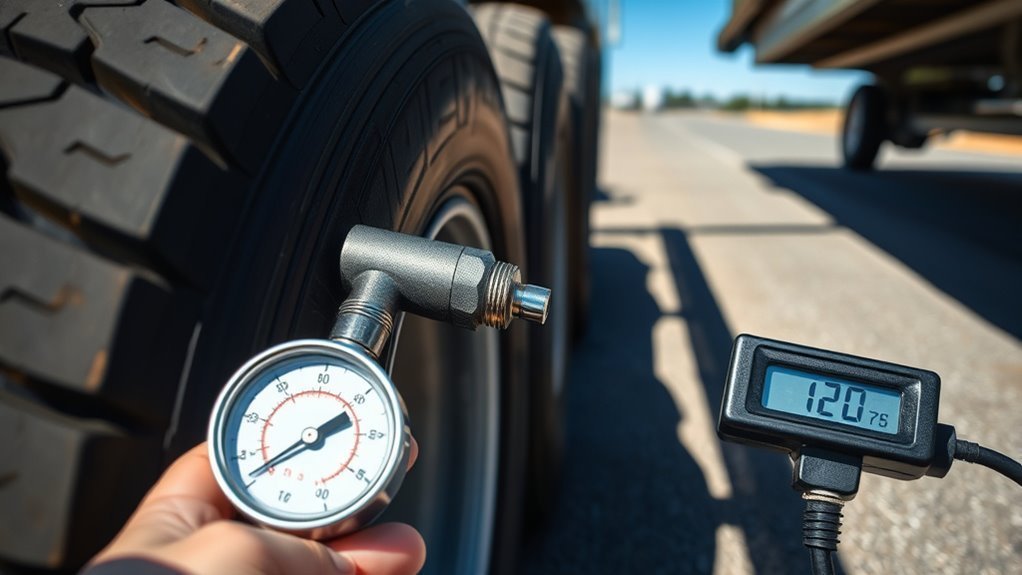
If one tire loses pressure, runs hotter, or wears differently, do not correct the symptom by guessing at a new PSI. Find the cause before towing again.
- One tire repeatedly loses air: Check for a puncture, leaking valve core or stem, bead leak, cracked wheel, or other damage. A tire that repeatedly needs air should be inspected by a qualified tire service professional.
- Tires on one side read hotter: Compare them after similar driving, shade, and sun exposure. If the difference persists, check side-to-side loading, pressure, brake drag, bearing condition, axle alignment, and tire damage.
- Center tread wears faster: Confirm cold pressure and actual load, but do not diagnose from the wear pattern alone. Also inspect alignment, wheel condition, tire matching, and suspension geometry.
- Shoulders or edges wear faster: Check pressure and loading, then inspect the axle, suspension, wheel bearings, and alignment. Wear on only one shoulder often points to an alignment or mechanical issue rather than pressure alone.
- Cracks, bulges, exposed cords, or separation appear: Stop using the tire. Do not attempt to make it safe by changing pressure.
- Cold pressure changes with the weather: Compare readings at similar ambient temperatures. If one tire drops faster than the others, investigate a leak rather than blaming temperature alone.
How Should Trailer Tire Pressure Be Adjusted for Temperature?
USTMA notes that tire pressure commonly rises or falls by about 1–2 PSI for every 10°F change in ambient temperature. This is a general estimate, not a correction formula. The safe method is to check the tires cold and reset them to the specified cold pressure when the seasons or morning temperatures change.
Do not release air merely because a hot tire reads above its cold target. Pressure normally rises as a tire flexes and heats during operation. If a warm tire is clearly low, NHTSA advises adding air to at least the specified cold pressure as a temporary safety measure, then checking and adjusting it again after the tire becomes cold.
A trailer that was correctly set in warm weather may be low on a cold morning. Recheck pressure after significant temperature changes, before long trips, and whenever the cargo or water load changes.
Essential Steps for Maintaining Optimal Tire Pressure
Trailer tire pressure is an ongoing maintenance item rather than a one-time setup:
- Check every tire cold before each towing trip. Also check at least monthly while the trailer is stored.
- Inspect the complete tire and wheel assembly. Look for pressure loss, cuts, punctures, cracks, bulges, uneven wear, exposed material, damaged valves, loose hardware, and wheel damage.
- Confirm the loaded weight. Stay within tire capacity, wheel capacity, hub and axle ratings, GAWR, GVWR, and the tow vehicle’s limits.
- Keep pressures matched across an axle. Use the same cold pressure at both ends unless the trailer or tire manufacturer specifies another method.
- Use suitable valve caps. They help keep contamination away from the valve core.
- Check the spare. Verify its pressure, size, load capacity, condition, age, and installation tools.
- Observe the tire and trailer speed limits. Do not use pressure changes to compensate for operation above a marked speed rating.
- Use TPMS as a backup. A trailer TPMS can warn about pressure loss or unusual temperature while moving, but it does not replace a manual cold-pressure check.
- Check the DOT Tire Identification Number. The final four digits show the week and year of manufacture. NHTSA notes that some vehicle and tire manufacturers recommend replacement at six to 10 years regardless of tread, but the exact inspection and replacement interval should come from the tire and trailer manufacturers.
Note: A TPMS is an early-warning tool, not the primary pressure-setting method. Begin each trip with a manual cold-pressure check using an accurate gauge.
Frequently Asked Questions
What is the 4 PSI rule?
The 4 PSI rule is a hot-versus-cold comparison sometimes used in general tire discussions, but it is not a universal trailer pressure-setting standard. Set trailer tires from the specified cold pressure on the trailer label or from confirmed manufacturer guidance. Do not use a generic 4 PSI rise to override the placard, tire load table, wheel limit, or tire-maker instructions.
What is the 5 PSI rule?
There is no universal 5 PSI rule for private trailer owners. A 5 PSI heat-correction value appears in a federal commercial-vehicle table for certain tires and operating conditions, but it is not a general target for recreational or utility trailers. Set pressure cold and do not bleed a hot tire down to the cold target.
What PSI should I keep my trailer tires at?
For the original tire-and-wheel configuration, use the cold PSI on the trailer certification label or in the owner’s manual. If the tire size, load range, wheel, or valve has changed, verify the operating pressure with the trailer and tire manufacturers and use an exact tire-maker load table when one applies.
Should trailer tires always be inflated to the maximum PSI on the sidewall?
Not automatically. The sidewall maximum pressure is associated with the tire’s maximum listed load. Some ST-tire and trailer manufacturers instruct owners to use that pressure, while other applications use a trailer placard or an approved load-inflation table. Follow the instructions for the exact trailer, tire, wheel, and valve combination, and never exceed the lowest pressure-rated component.
What is the best load range for a trailer tire?
Use a load range and tire size approved for the trailer that provide enough capacity at the intended pressure and speed. A higher letter is not automatically better. Confirm rim compatibility, pressure rating, tire dimensions, maximum load, speed rating, axle capacity, and the trailer manufacturer’s replacement requirements.
How often should I check trailer tire pressure?
Check every trailer tire and the spare before each towing trip and at least monthly during storage. Check again after major temperature changes, before a long trip, after changing the cargo or water load, or whenever one tire loses pressure or wears differently.
Can I lower trailer tire pressure for a softer ride?
Do not lower pressure solely to soften the ride. Lower pressure reduces load capacity and increases tire deflection and heat. Use a lower pressure only when the trailer and tire manufacturers provide an approved load-inflation method for the exact tire and measured load.
Conclusion
Start with the trailer certification label or owner’s manual when the original tires and wheels are installed. If the configuration has changed, verify the new operating pressure with the trailer and tire manufacturers instead of assuming that the sidewall maximum is correct. Check every tire cold, including the spare, keep the load and speed within all ratings, and do not tow with a tire that leaks, shows damage, or lacks enough pressure for its load.
Sources
- NHTSA TireWise: Tire Safety Ratings and Awareness — cold-tire definition, placard pressure, pressure checks, tire aging, TPMS, and damage inspection.
- U.S. Tire Manufacturers Association: Tire Care Essentials — monthly checks, cold pressure, temperature-related pressure changes, spare-tire checks, and TPMS limitations.
- 49 CFR §393.75 Tires — commercial-motor-vehicle tire condition, load, speed restriction, and cold-inflation requirements.
- Michelin RV Load and Inflation Tables — axle-end weighing, heavier-end pressure selection, matching pressure across an axle, and wheel-pressure limits.
- Kenda Specialty Tire Warranty and Safety Information — sidewall load and pressure markings, underinflation, overloading, heat, impact damage, and speed.
- Goodyear Tire Air Pressure Guidance — distinction between a manufacturer-recommended operating pressure and the maximum cold pressure marked on a tire.

