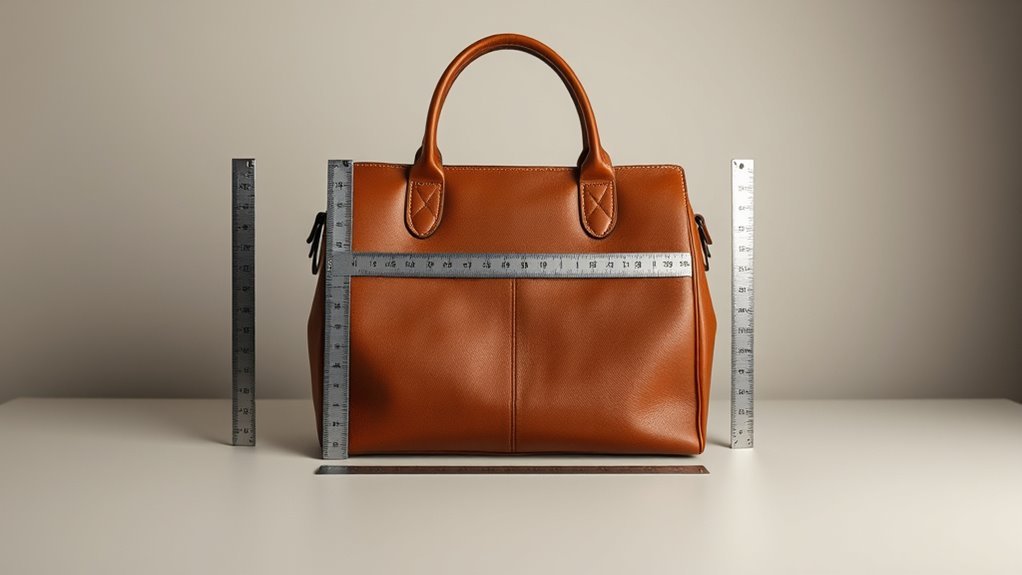
To measure a handbag, use a flexible tape on a flat surface. Measure the width across the widest part of the body, usually along the base or top, the height from the bottom to the top edge of the body without the handles, and the depth from front to back at the base. Note the strap drop separately, and write the numbers in the same units each time.
Why Handbag Measurements Matter
Size is one of the most important things to know about a bag, and it is also one of the easiest to misjudge from a photo. Dimensions tell you whether your phone, wallet, laptop sleeve or water bottle will fit, how the bag will look on your body and how it will feel to carry. Measurements are the best way to compare bags, and to check that a bag you plan to buy is the size you imagine. For the history of the form, see the history of handbags.
What You Need
- A flexible measuring tape, which follows the curves of a bag
- A ruler or straight edge, for checking flat sections
- A notebook or phone, to write down each number straight away
- A flat, level surface
How to Measure the Width
Place the bag upright on a flat surface. Measure across the front, from one side to the other, at the widest point. For a bag that is wider at the top than at the base, or the reverse, measure both, and note which is which. Do not include the handles or the straps in the width. If the bag has a flat base, measure along the base, since that is the space where objects will sit.
Common Width Mistakes
- Measuring around the curve of the bag, instead of straight across.
- Including handles, tassels or side pockets that stick out.
- Measuring the bag when it is stuffed full, so that the sides bulge.
How to Measure the Height
- Stand the bag upright on a level surface.
- Hold the tape straight, and measure from the bottom of the bag to the top edge of the body, in line with the opening.
- Do not include the handles. If you need the handle height, measure it separately, as the handle drop.
- Write down the result, with the units.
If the bag has a flap or a slouchy top, measure to the top of the main body, with the flap closed, and note it.
How to Measure the Depth
Depth is the distance from the front of the bag to the back, usually measured at the base, which is often the widest point. Place the bag upright, and hold the tape flat across the base. For a soft bag, note whether the bag was measured empty or full, since the depth can change. Depth decides how much the bag can hold, and whether larger items, such as a book or a lunch box, will fit.
Adjusting for Soft and Structured Bags
- A structured bag has fixed sides, so the measurements are reliable.
- A soft bag changes shape when it is filled, so measure the depth at the widest point, and add some allowance for contents.
- For a bag with a gusset, measure the gusset width at the base and at the top.
Strap Drop and Other Measurements
For a bag with a shoulder strap, measure the strap drop, which is the distance from the top of the strap, when it is held up, to the top of the bag. This tells you whether the bag will sit under your arm or at your hip. For adjustable crossbody straps, measure the shortest and longest lengths. See how to choose a strap length for a belt bag for a related guide. For bags with a round base, such as a bucket bag, see how to measure a bucket bag base, and for tote capacity, see how to measure tote bag capacity.
What Not to Do
- Do not mix units, such as inches for one number and centimeters for another.
- Do not estimate by eye or from a photo.
- Do not measure on a soft surface that distorts the bag.
- Do not forget to measure all three dimensions.
- Do not include handles in the body height, unless you note it separately.
How to Use Measurements When Shopping
Compare the numbers with the items you carry. Measure your phone, wallet, tablet or laptop, and check that it fits within the inside dimensions, with some room to spare. Check the width for what you can carry, the height for how the bag sits and the depth for how much it will hold. Some listings give outside measurements, and others give inside dimensions, so read the description carefully. If a bag is described as fitting a laptop, check the exact laptop size, as how to tell if a laptop fits in a tote bag with a sleeve explains.
Adjusting for Your Own Needs
A bag that suits one person may not suit another. If you are small, a very wide bag can look overwhelming, and if you carry a lot, a slim bag may be frustrating. Think about what you carry every day, and look for a bag with some extra space, since contents grow over time. Try an object of the same size in the bag you have at home, or cut a piece of cardboard to the dimensions, to see how it feels. For packing a bag well, see how to organize a purse.
Frequently Asked Questions
What Does L x W x H Mean?
It means length, width and height. For handbags, the width is usually the longest side, with the height and the depth following.
Which Is the Length, Width and Height of a Bag?
Width is across the front, height is from base to top and depth is from front to back. Brands may use length for the widest side.
What Is a Standard Size for a Shopping Bag?
Sizes vary widely, so there is no single standard. Check the measurements for each bag, and compare them with what you want to carry. See how to use a tote bag for groceries safely.
Conclusion
Measure the width, height and depth on a flat surface, with a flexible tape, and note the strap drop and the units. Compare the numbers with what you carry, and you will choose a bag that fits.
