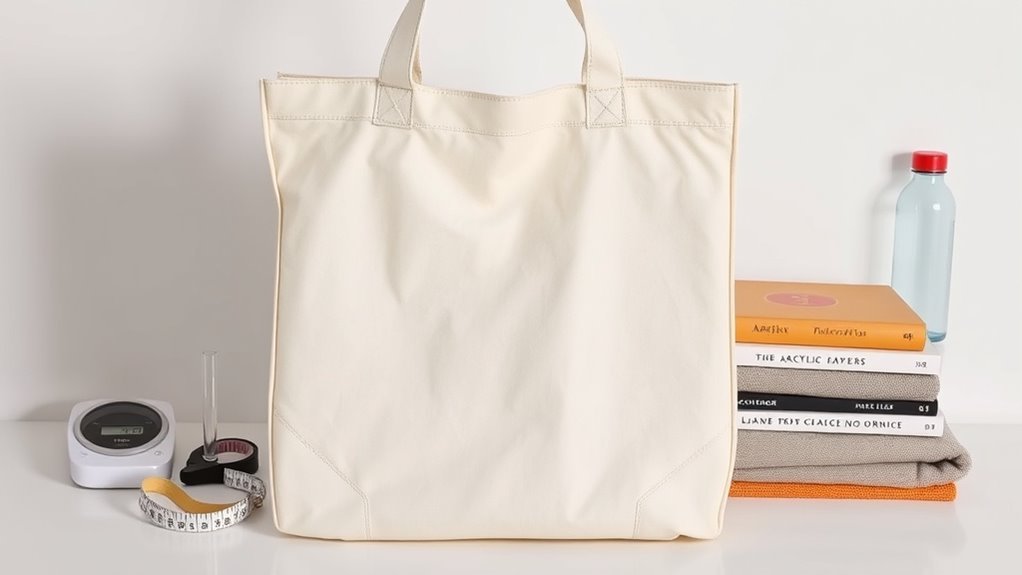
To measure your tote bag’s capacity beyond outer dimensions, focus on internal dimensions like height, width, and depth. Consider the shape and structure—taller bags hold items vertically, while wider bases support bulkier goods. Don’t overlook material properties; fabrics like canvas retain shape better than softer materials, affecting usable space. Also, account for gussets, which enhance storage. Use known-volume items to test fitting techniques. There’s more to discover about optimizing your tote’s capacity.
Why Internal Dimensions Matter for Tote Bag Capacity

When you’re choosing a tote bag, understanding the internal dimensions is essential because they directly affect its storage capacity. Internal measurements, including height, width, and depth, reveal how much you can fit inside without straining the bag.
Design elements like gussets and pockets can enhance storage efficiency, often making the bag feel more spacious than its external size suggests.
However, you should also consider how these compartments impact usable space. A tote with multiple pockets might limit the open volume available for larger items.
Additionally, the bag’s shape—whether it tapers or has a flat bottom—can influence how easily you can access your belongings.
How Shape and Structure Influence Your Tote’s Capacity
While choosing a tote bag, understanding its shape and structure is vital, as these factors greatly determine how much you can carry. A taller bag allows you to store larger items vertically, while a wider base provides stability for bulkier goods.
The gusset design plays an important role, enhancing capacity by creating more room for organized storage and preventing items from shifting during transport.
Gusset design significantly boosts capacity, allowing for organized storage and stability while on the go.
Additionally, consider how handle attachment affects your tote’s usability. Longer, reinforced handles enable you to carry heavier loads without sacrificing comfort.
This structural integrity guarantees that your bag can support various weights while maintaining its shape.
Why Material Flexibility Impacts Your Tote’s Usable Space
Understanding how material flexibility impacts your tote bag’s usable space is essential for effective packing. The right material can transform your packing experience, allowing you to maximize what you carry.
Here are some factors to take into account:
- Material types: Canvas holds shape, while softer fabrics sag under weight.
- Flexibility: Flexible materials expand, accommodating bulkier items effortlessly.
- Thickness: Thicker fabrics may reduce internal capacity, limiting load distribution.
- Durability: Understanding material properties helps you choose a tote that lasts while optimizing space.
Tips for Testing Tote Bag Capacity
Testing your tote bag’s capacity involves a few straightforward strategies that can help you maximize its potential. Start by using known-volume items, like standard containers or books, to gauge how much fits comfortably without straining the seams. Consider the material; canvas usually handles more weight than non-woven fabrics.
Next, evaluate the bag’s dimensions with the formula Length x Width x Height to estimate space. Test various filling techniques by loading the bag differently and observe how the weight distribution affects comfort.
Here’s a simple table to track your findings:
| Item | Volume (L) | Weight (kg) |
|---|---|---|
| Standard Book | 1.5 | 0.5 |
| Water Bottle | 1.0 | 1.0 |
| Lunch Container | 0.8 | 0.3 |
| Jacket | 0.5 | 0.4 |
Don’t forget to account for internal features that influence organization and capacity.
Avoid These Mistakes When Measuring Your Tote Bag’s Capacity
When measuring your tote bag’s capacity, it’s crucial to avoid common pitfalls that can lead to inaccurate assessments.
Paying attention to specific details guarantees you fully utilize your bag’s potential.
- Neglecting Internal Dimensions: Always measure height, width, and depth inside the bag; outer dimensions can mislead.
- Ignoring Gussets: Don’t overlook gusset measurements; these can greatly increase usable space.
- Failing to Take Material Thickness into Account: Remember, thicker fabrics can reduce overall volume, affecting what you can carry.
- Overlooking Handle Design: Measure handle length when the bag is full to guarantee easy access to contents.
Frequently Asked Questions
What Are the Dimensions of a Tote Bag?
A tote bag typically measures between 5.7” to 17” in width, 5.7” to 13½” in height, and 3” to 6.5” in depth. Understanding these dimensions helps you make capacity comparisons based on tote bag materials.
What Does 12x6x12 Bag Mean?
A 12x6x12 bag means it’s 12 inches tall, 6 inches wide, and 12 inches deep, translating to a capacity of 864 cubic inches. This size supports efficient weight distribution, ideal for your daily needs.
What Are the Dimensions of the Large Trader Joe’s Tote Bag?
The large Trader Joe’s tote bag measures 17 inches wide, 15 inches tall, and 6 inches deep. Its durable material enhances capacity factors, making it perfect for heavy loads while promoting easy, liberating transportation.
What Size Is a 40 * 30 * 15 Cm Bag in Inches?
A 40 cm by 30 cm by 15 cm tote bag converts to approximately 15.75 inches by 11.81 inches by 5.91 inches. For capacity calculations, consider these conversions essential for maximizing your bag’s potential.
Conclusion
In summary, measuring your tote bag’s capacity goes far beyond just its outer dimensions—it’s an adventure! By considering internal dimensions, shape, and material flexibility, you can reveal a world of hidden space. Don’t underestimate the importance of testing your bag either; you might discover it can hold everything from your laptop to a small mountain! So, next time you pack up, remember: your tote’s true capacity is waiting to be released, and it’s probably more than you ever imagined!