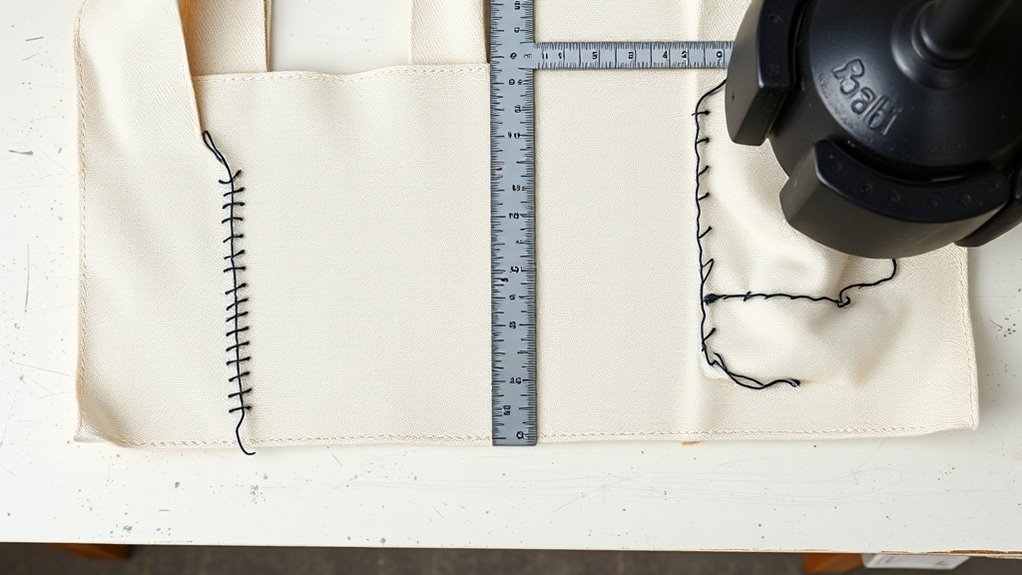
Stitch length affects how strong a bag seam is. For most bag fabrics, a medium stitch of about 2.5 to 3.5 mm works well. Shorten it to about 2 to 2.5 mm in high-stress places, such as handle attachments, and lengthen it for thick leather or heavy canvas, where holes that are too close together weaken the material.
Why Stitch Length Matters in Bag Making
A seam holds because the thread locks the layers together and spreads the load across many stitches. If the stitches are too long, there are too few of them to share the load, and the seam can pull apart or gape. If they are too short, the needle makes so many holes that the fabric weakens along the line, rather like the perforations on a sheet of stamps. The right stitch length is a balance, and it depends on the material, the thread and where the seam sits on the bag. See how to sew a tote bag with strong handles and neat seams for the wider picture.
How Stitch Length Relates to Seam Strength
Stitch length is usually set in millimeters on a modern machine, and many patterns talk about stitches per inch (SPI). To convert, divide 25.4 by the stitch length in millimeters, so a 2.5 mm stitch is about 10 stitches per inch, and a 3.5 mm stitch is about 7. A shorter stitch means more thread in each inch of seam, and a more evenly shared load. A longer stitch uses less thread and makes a seam that is easier to unpick, and it can look bolder as a decorative line.
Stitch Density and Strength
For woven fabrics, such as canvas or nylon, a stitch of about 2.5 to 3 mm is a common choice for seams that carry load. Going shorter than about 2 mm can start to cut the fabric, and going longer than about 4 mm leaves a seam that can pull open. Keep the stitch length even along a seam, because an uneven seam has weak spots where the stitches are far apart.
Material Stress and Balance
Different materials tolerate different stitch lengths. Thin fabrics need shorter stitches and finer needles, so that the seam stays flat and strong. Thick fabrics need longer stitches and heavier needles, so that the machine can feed the layers and the holes are not too close. Leather needs particular care, because needle holes are permanent, and a line of short stitches can act like a tear line.
Best Stitch Lengths for Different Bag Types
- Lightweight bags in nylon or polyester: about 2.5 to 3 mm, with a fine needle and matching thread.
- Cotton canvas totes: about 3 mm for general seams, and 2.5 mm for handle attachments.
- Heavy canvas, denim and similar fabrics: about 3 to 4 mm, with a heavy needle such as a denim needle.
- Leather: about 3.5 to 4.5 mm with a leather needle. Test on scraps, because needle holes cannot be undone.
- Topstitching and decorative seams: about 3.5 to 4 mm, since a longer stitch looks cleaner on the surface.
These ranges are guides, not rules. The thread, needle and fabric all affect the result, so test first. For fabric choice, see how fabric weave affects tote durability, and for a full project, see how to sew a tote bag.
Handles and Zippers
Handles carry the whole weight of the bag, so they deserve the strongest stitching. Use a shorter stitch of about 2.5 to 3 mm, stitch a box with an X through it where the handle meets the bag, and backstitch at the start and end. For zippers, use a medium stitch and a zipper foot, and keep the line close to the teeth. A stitch that is too long can cause rippling, and why purse zippers ripple after sewing or washing explains how to avoid it.
Adjust Stitch Length for Stress Areas
Stress areas include the handle attachments, the top edge near the opening, the corners of the base and the places where straps or D-rings are attached. Shorten the stitch in these places, add a second row of stitching and, if the fabric is thin, add a layer of interfacing or a small patch on the back. For load-bearing points, the stitch pattern matters as well as length. A box with a cross, or several rows of reinforcement, spreads the load better than a single line.
Common Stitch Length Mistakes
- Leaving the machine on the default setting for every seam, and every fabric.
- Using very short stitches everywhere, which can perforate the fabric and make seams hard to unpick.
- Using long stitches on handles and corners, where the load is highest.
- Changing the stitch length part way through a seam, which creates weak or uneven sections.
- Using thread that is too thin or too thick for the fabric and the needle.
Test and Fine-Tune on Samples
Before you sew the real bag, cut two layers of the same fabric and sew a few test seams with different stitch lengths. Pull each seam sideways to see how it holds, and look at the surface to check for puckering or cut threads. A stitch length of about 3 to 3.5 mm often works as a balance between appearance and strength, but your fabric may say otherwise. Write down the settings that work, so that you can repeat them. Seams also affect water resistance, as how bag seams affect water resistance describes, because every needle hole is a possible leak point.
Frequently Asked Questions
What Is the Strongest Stitching Pattern?
For ordinary machine sewing, the lockstitch is the standard and a reliable choice. For high-stress points, combine it with backstitching or a boxed X.
How Many Stitches per Inch Is Good?
About 8 to 12 stitches per inch suits most fabrics, with fewer stitches per inch for thick materials and more for fine ones.
How Do I Improve Seam Strength?
Use a suitable stitch length, matching thread and needle, add reinforcement at stress points and sew a second line where the load is high.
What Stitch Length Is Best for Stay Stitching?
About 2.5 mm is typical, but it depends on the fabric.
Conclusion
Stitch length is a small setting with a large effect. Choose a medium length for general seams, shorten it where the load is high, lengthen it for thick materials and test on scraps before you sew the bag.