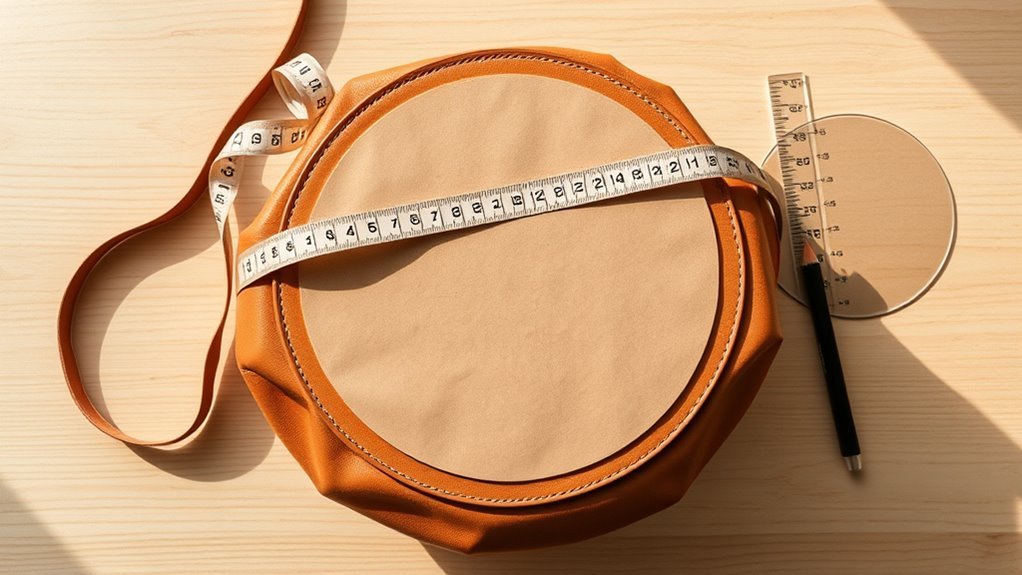
To measure your bucket bag base for a round lining, start by using a flexible measuring tape to find the diameter at the widest point. Multiply the diameter by π for the circumference. For height, measure from the base to the drawstring, subtracting any base depth and adding seam allowances. Create a template on paper, adding a seam allowance around the traced circle. Perfecting these steps guarantees a snug fit that enhances your bag’s look, and there’s more to explore.
Why Accurate Measurements Matter for Your Bucket Bag Lining
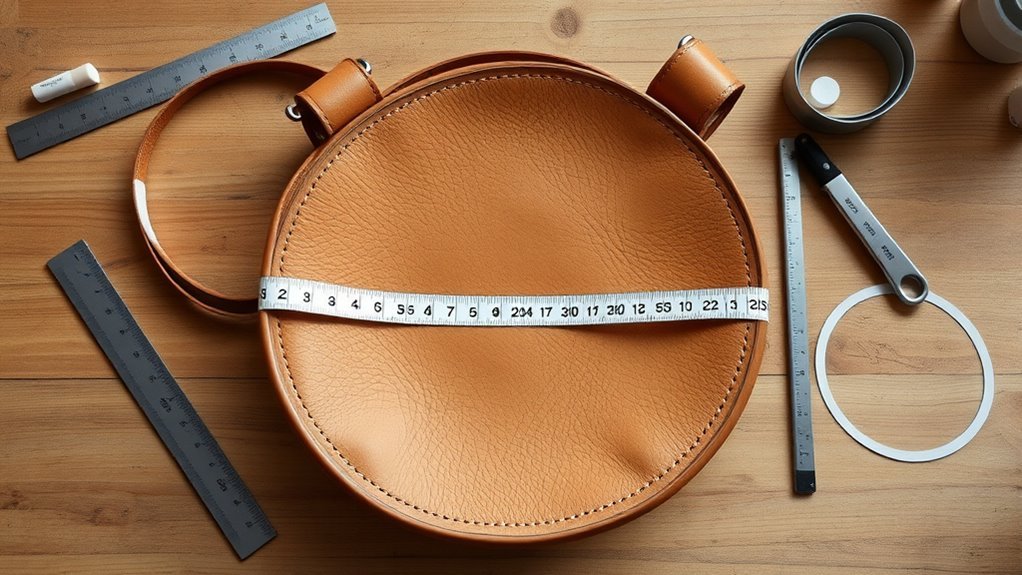
Accurate measurements are the backbone of a well-crafted bucket bag lining. When you measure precisely, your round lining fits snugly, preventing sagging and ensuring your bag maintains its shape. This attention to measurement importance allows you to create a cleaner, more professional finish, enhancing the overall visual appeal of your project.
Accurate measurements ensure a snug fit for your bucket bag lining, enhancing both its shape and visual appeal.
Don’t overlook seam allowances, typically ranging from 1/4 to 1/2 inch; they’re essential for durability and fit. A well-measured base helps you avoid misalignment during assembly, keeping your lining and main fabric in harmony. This balance not only elevates your bag’s aesthetic but also its functionality.
Taking the time to measure accurately saves you both time and material. You’ll minimize the likelihood of needing to re-cut or adjust your lining materials, liberating you to focus on the creativity and joy of your craft.
Precision in your measurements empowers your designs and elevates your sewing experience.
Tools You’ll Need for Accurate Bucket Bag Measurements
To get the perfect fit for your bucket bag lining, you’ll need a few essential tools at your side.
A flexible measuring tape is vital for precise diameter measurements, while a compass can help you trace a flawless base shape.
With these tools and some accurate techniques, you’ll guarantee consistency in every measurement, setting you up for a successful project.
Essential Measuring Tools
When measuring a bucket bag base, having the right tools on hand can make all the difference.
These essential measuring tools not only enhance your measuring techniques but also guarantee your fabric considerations are met with precision.
- Flexible Measuring Tape: Perfect for accurately measuring the circumference and diameter.
- Ruler or Straight Edge: Helps confirm straight lines for even measurements across the base.
- Fabric Marker or Chalk: Ideal for marking measurements without leaving permanent marks.
With these tools, you can confidently create a beautifully shaped bucket bag.
Always double-check your measurements against the pattern dimensions before cutting to ensure your design comes to life just as you envision it.
Embrace the freedom of crafting with accuracy!
Accurate Measurement Techniques
With the right tools in hand, measuring your bucket bag base becomes a straightforward task that sets the stage for success. Use a flexible measuring tape to get the diameter at the widest point. Start by measuring the circumference and divide by π (approximately 3.14) for precision. Place cardboard beneath the bag to create a flat surface, guaranteeing an accurate measure. A ruler or straightedge can help confirm evenness on both sides. Always double-check your measurements before cutting your lining materials to secure a snug fit.
| Tool | Purpose | Tips |
|---|---|---|
| Flexible Measuring Tape | Measure circumference and diameter | Measure at the widest point |
| Cardboard | Create a flat surface | Prevent distortion |
| Ruler | Ensure consistency | Check measurements align |
Tips for Consistency
Achieving consistency in your bucket bag measurements hinges on using the right tools and techniques.
To create a flawless lining, equip yourself with essential items that enhance your sewing experience:
- Flexible measuring tape: Perfect for capturing the circumference of your bag’s base.
- Clear ruler or straightedge: Guarantees precise cuts and straight edges when working with fabric choices.
- Tailor’s chalk or fabric marker: Marks your fabric accurately, preventing misalignment during assembly.
Step-by-Step Guide to Measuring the Diameter of Your Bucket Bag
Measuring the diameter of your bucket bag’s base is essential for a precise fit, so let’s get started.
You’ll need a measuring tape or ruler, and a flat surface to guarantee accuracy.
Measuring Bag Base Accurately
To accurately measure the base of your bucket bag, you’ll want to start with a flexible measuring tape for the best results. Here’s how to get it right:
- Confirm the bag’s base is even: Place it on a flat surface to avoid inaccuracies.
- Measure the diameter: For circular bases, measure straight across the center; if it has boxed corners, factor in their width.
- Record your measurements immediately: This keeps everything clear, especially when considering various bucket bag styles and fabric choices.
Taking these steps helps confirm your lining fits beautifully, allowing your creativity to shine through each stitch.
Embrace the process, and free your design potential!
Tools Needed For Measurement
When measuring the diameter of your bucket bag base, having the right tools can make all the difference. Start with a flexible measuring tape, as it hugs the circular edge for accuracy. Place it flat against the bag’s bottom, ensuring it touches the outer edges for precise results.
To enhance your measuring techniques, consider the following measurement tools:
| Tool | Purpose |
|---|---|
| Flexible Measuring Tape | For accurate diameter measurement |
| Ruler | To double-check dimensions |
| Calculator | To average measurements |
Measure at two perpendicular points to account for irregularities, recording your results in inches or centimeters. Don’t forget to add seam allowances for a perfect lining fit!
Common Measuring Mistakes to Avoid
Accurate measurements are essential for achieving the perfect bucket bag, and a few common pitfalls can derail your efforts. Avoid these common errors to guarantee your round lining fits just right:
- Measuring an empty bag: Always fill your bag lightly before measuring the base. This gives you a true representation of its shape.
- Neglecting seam allowances: Don’t forget to add 1/4 to 1/2 inch for seam allowances, based on your sewing technique. Skipping this step can lead to a tight fit.
- Forgetting to double-check: Always compare your measurements with the pattern dimensions before cutting. A quick verification can save you from wasting material and time.
How to Determine the Height for Your Lining?
Measuring the height for your bucket bag lining is just as important as getting the base right. Start by measuring the total height of the bag from the base to the drawstring opening.
Next, subtract the depth of your bucket bag’s base from this total height to find your lining height. If your bag features boxed corners, don’t forget to add that depth measurement to guarantee your lining fits snugly.
To guarantee a flawless finish, include seam allowances—typically about 1/4 inch—in your height calculation. For added versatility, consider incorporating an extra inch to your lining height. This gives you the freedom to make adjustments and achieve a neat top edge.
Essential Tips for Accurate Bucket Bag Measurements
To achieve the perfect fit for your bucket bag, it’s essential to focus on precise measurements that reflect your design vision. Start by determining the desired diameter of your circular lining, guaranteeing it matches the bag’s width at the bottom. Use a flexible measuring tape for accuracy and divide the total circumference by π (about 3.14) to find the diameter.
Achieving the perfect fit for your bucket bag begins with precise measurements of the circular lining’s diameter.
Here are some essential tips:
- Account for boxed corners: Add the desired depth to your base diameter for that expanded shape.
- Double-check measurements: A small error can lead to an ill-fitting lining, so verify before cutting.
- Use a pattern template: This guarantees consistent size and shape across various bucket bag styles.
With these fabric considerations in mind, you’ll be well on your way to crafting a beautifully tailored bucket bag that fits your vision perfectly.
How to Adjust Measurements for Various Bag Sizes?
How do you guarantee your bucket bag fits perfectly across various sizes? Start by determining the base diameter, confirming it aligns with your desired bag circumference. Use the formula (C = pi times d); for instance, a small bag might need a base diameter of 4.5 inches, while an X-Large could stretch to 7.5 inches.
Keep fabric types in mind as you adjust measurements; different materials can alter how the bag holds its shape.
Don’t forget the seam allowance—typically 1/2 inch—which can impact your final dimensions. If you’re creating boxed corners, add the corner depth to both width and length measurements.
Always measure and cut your lining pieces to match the outer fabric’s final dimensions. This guarantees a snug fit, liberating your creativity while crafting a beautifully tailored bucket bag that shines in any size variation.
Creating a Template for Your Bucket Bag Lining
Creating a precise template for your bucket bag lining starts with the right measurements, ensuring a snug fit. First, measure the diameter of your bag’s base and mark the center on a piece of paper. Use a compass or round object to trace a circle with the same diameter, then add a seam allowance of about 1/4 inch around the traced circle. Cut it out and test it in your bag to confirm it fits well before cutting your lining materials.
To enhance your template, consider these points:
- Boxed corners: Add depth and stability by measuring additional dimensions.
- Template adjustments: Modify your design based on testing for a more tailored fit.
- Lining materials: Choose fabrics that complement your bag’s aesthetic while ensuring durability.
With these steps, you’re one step closer to crafting a beautifully lined bucket bag!
Conclusion: Perfecting Your Bucket Bag Lining
Perfecting the lining of your bucket bag is the final touch that elevates your creation from good to great. Start by measuring the base diameter with a flexible measuring tape for precision. Remember to add seam allowances of 1/4 to 1/2 inch to guarantee a snug fit.
When you cut your lining fabrics, mirror the bag’s shape for that polished finish you desire.
Before final assembly, test the lining by temporarily attaching it to your bag. This allows you to check the fit and make any necessary adjustments, assuring a flawless look.
Using proper fitting techniques, you’ll prevent excess fabric from bunching, which can detract from your bag’s overall professionalism.
With attention to detail and the right measurements, you’re not just making a bag; you’re crafting a statement piece that embodies your unique style. Embrace the process, and let your creativity shine!
Frequently Asked Questions
How Do I Put a Lining in a Bag?
To put a lining in your bag, choose suitable lining materials, cut them to fit your bag construction, and sew the edges. Secure it neatly at the top, ensuring a polished finish. Enjoy your creation!
What Is the Width of a Bag?
A bag’s width is like a warm embrace, measuring across its base from seam to seam. Understanding bag dimensions guarantees you choose the right lining materials, creating a perfect fit for your stylish creation.
How Do I Make a Bucket Bag?
To make a bucket bag, select your materials wisely. Design tips include cutting fabric accurately, ensuring seam allowances, and adding depth with boxed corners. Assemble carefully for a stylish, functional bag that reflects your unique style.
How Big Is a Bucket Bag?
A bucket bag typically dances between 4.5 to 7.5 inches in diameter. Embrace those dimensions; mastering round lining techniques guarantees your bag feels just right, liberating your style while keeping practicality in mind.
Conclusion
In the world of crafting, precision is your best friend. By taking accurate measurements for your bucket bag lining, you’re not just creating a functional piece; you’re weaving a story of style and practicality. Remember, the right fit transforms a simple bag into a stunning accessory. So, grab your tools and let your creativity flow—each measurement you take is a step towards making your bucket bag truly yours. Happy crafting!