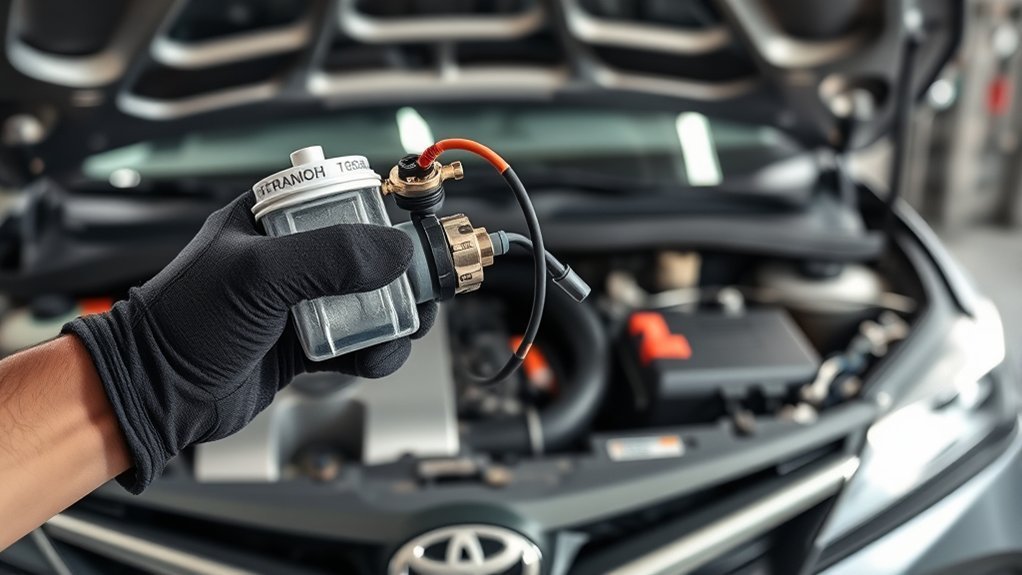
A Toyota Camry EVAP system fault means the car detected a vapor leak, incorrect purge flow, a vent or leak-detection-pump problem, or an abnormal pressure-sensor signal. Start by recording every stored, pending, and permanent OBD-II code. Then identify the fault family. Leak codes call for cap, hose, valve-sealing, and smoke checks. Purge-flow faults call for purge-valve and flow-path testing. Pump, vent, reference-orifice, and pressure-sensor codes require circuit and active-test diagnosis. Do not replace the charcoal canister or a valve until the correct test proves it failed. If you smell strong fuel or see wet fuel, stop testing and arrange professional repair.
Last updated: July 31, 2026 — clarified federal leak-threshold wording, added later Toyota pump and pressure-sensor code families, and separated leak, purge, vent/pump, and sensor diagnostic paths.
Quick Answer
The Camry EVAP system stores fuel vapor in a charcoal canister and later sends it to the engine through the purge circuit. Diagnose a fault by code family, not by guessing a part. Check the fuel cap and visible damage for leak codes. Test purge-valve sealing and commanded flow for purge faults. Use the correct circuit, active, pressure, or EVAP-rated smoke test for vent, pump, sensor, and very-small-leak faults. Match every procedure to the Camry’s year, engine, hybrid configuration, market, and emissions calibration.
What’s in This Article
- Camry EVAP Codes and First Checks
- Which Camry EVAP Test Should You Use?
- What the Toyota Camry EVAP System Does
- Key Camry EVAP Components
- How the System Works During Normal Operation
- Common EVAP Fault Symptoms
- How OBD-II EVAP Self-Tests Work
- Home Checks for a Camry EVAP Fault
- How to Locate EVAP Leaks and Component Faults
- Repairs Matched to a Failed Test
- Differences by Year and Model
- Preventive Maintenance
- Frequently Asked Questions
Key Takeaways
- Record stored, pending, and permanent codes before clearing anything.
- Separate leak codes from purge-flow, vent/pump, reference-orifice, and pressure-sensor codes.
- Check the correct fuel cap and its seal first for a leak code, but do not assume every EVAP fault is a cap problem.
- Use a professional EVAP-rated smoke, pressure, vacuum, circuit, or active test that matches the code and model year.
- Verify the repair by checking code status and readiness after the required driving or key-off monitor completes.
Camry EVAP Codes and First Checks at a Glance
An EVAP code identifies the system behavior or test that failed. It does not prove that the part named by a generic scanner description is defective. Use the complete code, code status, symptoms, freeze-frame data, related codes, and the model-specific Toyota diagnostic procedure together.
| Code or symptom | Fault family | First check | Next confirmation |
|---|---|---|---|
| P0440 | General EVAP system fault | Related codes, cap, hoses, connectors | Follow the year-specific diagnostic chart |
| P0441 or enhanced P0441 subcodes | Incorrect purge flow or purge actuator fault | Purge hose, connector, command data, valve sealing | Active test and specified vacuum or flow test |
| P0442 | Small EVAP leak | Cap seal, filler neck, visible vapor lines | Controlled EVAP smoke or sealing test |
| P0446 | Vent-control or system-response fault | Vent path, wiring, connectors, blockage, related codes | Active test, circuit checks, and pressure response |
| P0450–P0453 | EVAP pressure-sensor circuit or signal fault | Connector, wiring, reference voltage, ground, sensor hose where used | Compare scan data with Toyota limits and circuit tests |
| P0455 | Large or gross leak | Missing or loose cap, disconnected hose, obvious damage | Smoke test and valve-sealing test |
| P0456 or P045600 | Very small EVAP leak | Cap seal, filler neck, small hose cracks, valve sealing | Low-pressure EVAP smoke or Toyota system check |
| P043E, P043F, P2401, P2402, P2419 or enhanced equivalents | Leak-detection pump, reference-orifice, switching-valve, module, or circuit fault | Read the complete code cluster; inspect module wiring, connectors, air inlet, and vent path | Toyota active test, pressure test, and circuit diagnosis |
| Hard start after refueling | Possible excessive purge flow | Check for P0441 or related purge codes | Test whether the purge valve seals when commanded closed |
| Strong fuel odor | Possible vapor or liquid-fuel leak | Stop near ignition sources and look only for obvious wet fuel | Professional inspection before driving if severe |
For a dedicated very-small-leak workflow, see the Camry P0456 diagnostic guide. For broader scanner terminology and code status, see the Camry OBD-II scanner guide.
Which Camry EVAP Test Should You Use?
The correct test depends on the fault family. A smoke test is useful for a leak but may not prove why a valve command, sensor circuit, reference orifice, or leak-detection pump failed. Use the code and symptom to choose the first test instead of starting with the most expensive component.
| Fault family | Best first diagnostic path | Do not assume |
|---|---|---|
| Leak code: P0442, P0455, P0456 | Inspect the cap, filler neck, accessible hoses, valve sealing, and then use an EVAP-rated smoke or system test | The charcoal canister is automatically bad |
| Purge-flow code or hard start after refueling | Check the purge hose and connector, command the valve if supported, and verify that it seals when off and flows when on | A new fuel cap will correct excessive purge flow |
| Vent, pump, reference-orifice, or switching-valve code | Inspect the vent intake, wiring, connector, shared module, pressure response, and active-test result | Each code in a cluster represents a separate failed part |
| Pressure-sensor code | Check sensor data, reference voltage, ground, signal wiring, connectors, and connected hoses before replacing the sensor | A pressure-sensor code proves an external vapor leak |
| Strong fuel odor or wet fuel | Stop home testing, remove ignition sources, and arrange qualified inspection | The car is safe because the stored code is only an EVAP code |
What Does the Toyota Camry EVAP System Do?

The Toyota Camry EVAP system is a sealed fuel-vapor management circuit. Gasoline releases vapor inside the tank. Vapor lines route it to a charcoal canister, where activated carbon stores it until the engine can draw it through the purge circuit and burn it.
When operating conditions are correct, the engine control module commands the purge circuit. Intake vacuum draws stored vapor into the engine. Fresh air enters through the vent side so the canister can release vapor in a controlled way.
The OBD system also checks whether the vapor system seals and whether its valves, pump, pressure signal, and flow response behave as expected. Federal requirements for model-year 2017 and later vehicles require detection of an effective 0.020-inch EVAP leak when approved monitoring conditions are satisfied. Older Camrys may also detect small leaks, but their hardware, DTC logic, thresholds, and test procedures vary. Always use service information for the exact year, engine, market, and emissions label.
Key Camry EVAP Components: Tank, Canister, Purge, Vent, Pump, and Sensor
The main EVAP parts include the fuel tank and filler neck, charcoal canister, purge valve, vent path, pressure-sensing circuit, vapor hoses, and electrical connectors. Depending on the model year, a canister pump module may combine the leak-detection pump, switching or vent valve, pressure-related functions, and a calibrated reference orifice.
Fuel Tank Role
Your Camry’s fuel tank connects to vapor lines, valves, a pressure-sensing circuit, and the canister. Those parts allow the system to contain vapor, purge stored vapor, and test for leaks or incorrect component response.
Inspect the tank area only from a safe position if you smell fuel, see impact damage, or keep getting EVAP leak codes. Do not disconnect fuel or vapor lines without the correct depressurization, lifting, and service procedure.
| Component | Purpose | Common fault clue |
|---|---|---|
| Fuel tank and filler neck | Contain liquid fuel and vapor | Fuel odor, impact damage, corrosion, cap-sealing issue |
| Charcoal canister | Stores fuel vapor | Cracked housing, liquid-fuel saturation, internal restriction |
| Canister pump module or leak-detection assembly | Supports key-off pressure and leak monitoring on equipped models | Pump, reference-orifice, switching-valve, or shared code cluster |
| EVAP pressure sensor | Reports tank or system pressure to the ECM | Implausible data, circuit codes, no response during active tests |
Purge and Vent Valves
The purge valve meters stored vapor from the canister into the intake. If it leaks when commanded closed, the engine can receive vapor at the wrong time. That can contribute to hard starting, an extended crank, or rough running after refueling. If it does not open or the flow path is restricted, the computer may store an incorrect-purge-flow code.
The vent circuit allows filtered air into the canister during normal purge and helps seal or route the system during leak testing. A blocked air inlet, damaged wiring, restricted hose, or valve that does not move as commanded can cause refueling trouble, incomplete tests, or vent and pump-related codes.
Toyota changed valve names, component locations, connectors, code suffixes, and test strategies across Camry generations. Do not apply one year’s pinout, resistance specification, pressure limit, or active-test procedure to another.
How the Camry EVAP System Works During Normal Operation
While the Camry is parked or running, the canister holds fuel vapor that would otherwise escape. When engine temperature, load, speed, and other conditions are suitable, the ECM commands purge. Vapor moves from the canister to the intake, and filtered air enters through the vent side.
The computer watches pressure change, purge response, valve operation, and pump or reference behavior where equipped. Some older systems perform more of the test while driving. Many later Camrys use a key-off leak-detection sequence after the car has been parked long enough for fuel temperature and tank pressure to stabilize.
A pressure pattern that does not match the expected result can indicate an external leak, restricted line, purge valve that failed to seal, blocked vent, pump or switching-valve fault, damaged circuit, or pressure signal outside the expected range. The DTC narrows the test. It does not identify the failed part by itself.
Common Camry EVAP Fault Symptoms
The most common sign of a Camry EVAP fault is a solid check engine light. Other clues include fuel odor, hard starting after refueling, rough idle immediately after a fill-up, a fuel nozzle that repeatedly clicks off, a “Check Fuel Cap” message on supported models, or a failed emissions inspection. Confirm the cause with code status and testing because these symptoms can have non-EVAP causes.
Check Engine Light
A first failed monitor may create a pending code. A repeated failure can create a confirmed code and command the check engine light, depending on the fault and calibration. Common generic EVAP codes include P0440, P0441, P0442, P0446, P0455, and P0456. Later Camrys may also report enhanced subcodes or pump, switching-valve, reference-orifice, and pressure-sensor codes.
For a leak code, check the fuel cap before invasive tests. Tighten the correct cap until it clicks, then inspect the gasket and filler-neck sealing surface for dirt, cracks, deformation, corrosion, or damage. Use a cap designed for the exact vehicle. A cap that looks normal can still fail a sealing test, but replacing it blindly will not fix purge-flow, pump, wiring, sensor, or vent-control faults.
Strong Fuel Odor
A strong fuel odor can come from an EVAP vapor leak, damaged vapor line, cracked canister, filler-neck problem, or liquid-fuel leak. Treat it as a safety issue. Park outdoors away from flames, sparks, heaters, electrical work, and smoking areas.
Look only for obvious wet fuel or visible damage without crawling under an unsupported vehicle. If you see liquid fuel, the odor is heavy inside the cabin, or fumes continue while parked, do not continue home testing or normal driving. Arrange a qualified inspection or tow.
Warning: Fuel vapor can ignite. Never smoke, use an open flame, create sparks, or use a homemade smoke generator near the fuel or EVAP system.
How Camry OBD-II EVAP Self-Tests Work
Your Camry does not run the EVAP monitor continuously. The ECM waits for enabling conditions involving fuel level, temperature, tank pressure, battery voltage, driving history, and time since shutdown. If those conditions are not met, the monitor can remain “not ready” even after a correct repair.
During a monitor, the system may command purge, close or switch valves, operate a leak-detection pump, create vacuum, measure a reference restriction, and compare pressure changes. The exact sequence depends on the Camry’s year and engine. A result outside the expected range may indicate a leak, restriction, purge fault, vent fault, pump fault, sensor fault, or electrical problem.
On many 2007–2024 Camry systems, a key-off leak check can begin about five hours after shutdown. The test may start later if the engine or fuel has not cooled enough. This timing is not universal, and owners should not use it as a substitute for the exact Toyota monitor procedure.
Two public leak-size references are often quoted, but they describe different regulatory or inspection contexts. The current federal certification provision expressly requires model-year 2017 and later test vehicles to detect an effective 0.020-inch leak when monitoring conditions are satisfied. The New York Vehicle Inspection Program’s EVAP explanation uses 0.040-inch and 0.020-inch equivalents to describe broad OBD generations. Treat the inspection-program figures as general guidance, not as the Toyota diagnostic threshold or procedure for a specific Camry.
If your only problem is incomplete readiness after a repair or code reset, use the dedicated Camry EVAP monitor not-ready guide.
Step-by-Step Home Checks for a Camry EVAP Fault
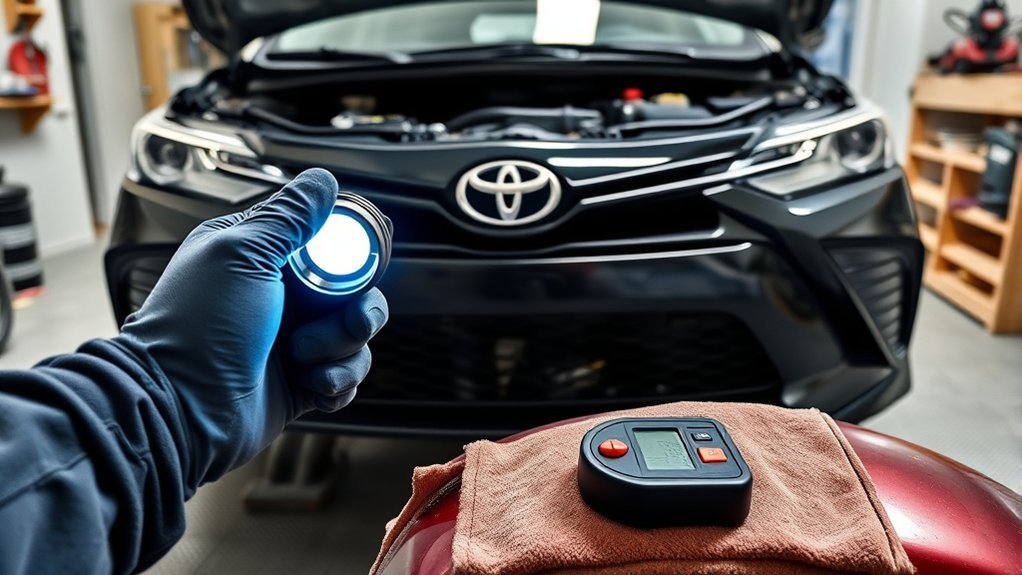
Safe DIY diagnosis should begin with non-invasive checks. You need an OBD-II scanner, flashlight, gloves, correct service information, and a well-ventilated work area. Keep the vehicle on level ground with the parking brake set.
Visual Fuel System Inspection
Start with parts you can inspect without lifting the car or opening the fuel system. Look at the cap gasket, filler-neck sealing surface, accessible vapor hoses, purge-valve connector, and visible canister, vent, pump, or pressure-sensor wiring. Do not assume a hose is safe to remove because it looks easy to reach.
Use this order:
- Record stored, pending, and permanent codes, freeze-frame data, and readiness status.
- Where available, save fuel level, engine runtime, coolant temperature, intake-air temperature, ambient-temperature, EVAP-pressure, and purge-command data.
- Identify whether the code belongs to the leak, purge, vent/pump, reference-orifice, or pressure-sensor family.
- For a leak code, tighten the correct fuel cap until it clicks and inspect its gasket and mating surface.
- Check visible vapor hoses for cracks, loose ends, rubbing, collapsed sections, or recent repair damage.
- Inspect accessible electrical connectors for corrosion, broken locks, moisture, or pulled wires.
- Check for obvious canister, filler-neck, vent-inlet, or underbody impact damage without going under an unsupported car.
- Use the diagnostic chart for the exact code before testing or replacing a valve, sensor, pump, or canister.
| Component | What to look for | Safe next step |
|---|---|---|
| Fuel cap and filler neck | Loose cap, cracked gasket, dirt, corrosion, damaged sealing surface | Clean the surface or test the VIN-correct cap |
| Visible vapor hoses | Cracks, disconnection, rubbing, collapsed section | Follow the service procedure before removal |
| Purge-valve connector and hose | Loose lock, corrosion, damaged wiring, cracked hose | Repair the circuit or hose before condemning the valve |
| Canister pump, vent, or air inlet | Impact damage, dirt blockage, moisture, broken mount, damaged connector | Use the code-specific active and circuit tests |
| Pressure-sensor circuit | Damaged wiring, disconnected hose, implausible scan reading | Check reference voltage, ground, signal, and specified response |
To locate the connector before scanning, see where to find the Camry OBD-II port.
When to Use a Professional Smoke, Pressure, or Vacuum Test
Use a smoke or sealing test when a leak code’s diagnostic chart calls for one and the cap and visual checks do not reveal the cause. The safest choice is an automotive EVAP-rated machine or Toyota-specified tester connected at the approved point. The system may need a scan tool to command a vent or switching valve before it can be sealed correctly.
A smoke test is not the automatic first test for a pressure-sensor circuit code, pump-control code, or reference-orifice code. Those faults may require voltage, ground, resistance, scan-data, active-test, vent-path, and pressure-response checks before leak testing.
Do not connect unrestricted shop air, pressurize through the fuel filler, or use a homemade smoke source. Excess pressure can damage valves or the tank, force vapor out, and create a fire hazard. A hand vacuum pump is appropriate only for a component and procedure that the correct Toyota service information identifies.
Locate EVAP Leaks and Component Faults With the Correct Tools
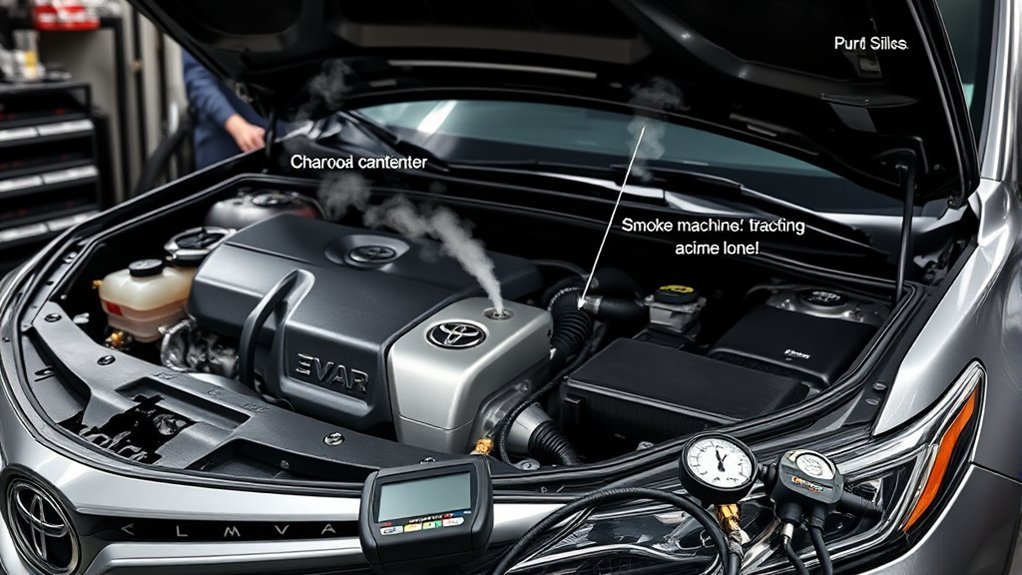
A reliable Camry EVAP diagnosis combines code status, scan data, circuit checks, and a controlled leak or component test. Start with every code and its status. Review freeze-frame information, then follow Toyota’s diagnostic order. Purge, vent, pump, or pressure-sensor faults may need to be resolved before a leak-code result can be interpreted correctly.
| Tool | What it can confirm | Key limitation |
|---|---|---|
| OBD-II scanner | Codes, status, freeze frame, readiness, selected live data | A code does not prove a part failed |
| Bidirectional scan tool | Valve commands and EVAP active tests on supported models | Coverage and menu labels are vehicle- and tool-specific |
| EVAP smoke or pressure tester | Visible external leak path or failure to hold specified low pressure | System must be connected, sealed, and pressurized correctly |
| Hand vacuum pump | Whether a specified valve or hose holds vacuum | Not a substitute for the full-system procedure |
| Multimeter | Power, ground, voltage drop, resistance, or continuity | Use the correct pinout and limits |
| Toyota service information | Test order, limits, pinouts, code suffixes, and active-test steps | Must match VIN, engine, market, and calibration |
How to Interpret Common EVAP Test Results
- Smoke appears at a cap, line, valve body, canister seam, or tank connection: repair the proven leak, then repeat the test to check for a second leak.
- The purge valve has suction when commanded off: confirm the hose routing and valve-sealing procedure; a purge valve that does not seal may cause after-refueling starting problems.
- The pressure reading does not respond when valves or the pump are commanded: diagnose the pressure sensor, wiring, blocked hose, pump, switching valve, or module before replacing leak-related parts.
- Several pump/reference-orifice codes appear together: treat them as a shared-system clue and follow the combined Toyota diagnostic chart instead of replacing several separate parts.
- No external smoke appears during a P0456 test: verify that the system was sealed correctly and test cap sealing, valve leakage, pressure response, and inaccessible tank-area connections.
Document the starting data and every result. After the repair, compare code status and readiness with the original scan rather than judging success only by whether the light is off.
Pro tip: Recheck pending and permanent codes after the repair. A pending code can return before the check engine light, and a permanent DTC clears only after the OBD system completes the required evaluation and confirms the fault is no longer present.
Camry EVAP Repairs Matched to a Failed Test
A correct repair matches the failed test. A cap should be replaced because it is damaged, incorrect, or fails a cap-sealing test. A purge valve should be replaced because it fails its electrical, commanded-flow, or closed-sealing test. The same evidence-first rule applies to hoses, wiring, pressure sensors, vent hardware, pump modules, and canisters.
| Confirmed result | Likely repair | Required follow-up |
|---|---|---|
| Cap gasket damaged or cap fails sealing test | Install the correct cap and clean the filler-neck sealing surface | Rerun the applicable monitor or leak test |
| Smoke or pressure loss at a hose or connection | Repair or replace the damaged vapor line, seal, or fitting | Repeat the full-system leak test |
| Purge valve leaks when commanded closed or fails commanded flow | Repair its circuit or replace the proven faulty valve | Confirm purge response and monitor completion |
| Vent or pump circuit fails voltage, ground, resistance, or active test | Repair wiring, connector, vent path, or the proven faulty module | Repeat the active and system checks |
| Pressure signal remains implausible after circuit and hose checks | Replace the confirmed faulty sensor or integrated assembly | Verify atmospheric and commanded pressure response |
| Canister housing leaks or is confirmed saturated or restricted | Replace the canister and correct the cause of contamination | Check for overfilling, blocked venting, and related valve faults |
Use the correct cap and VIN-matched parts. Repair wiring or connector faults before installing a new valve or module. Replace a cracked or fuel-saturated canister only after confirming the failure and its cause. Repeated topping off after the pump clicks can send liquid fuel into components designed mainly for vapor.
After repair, save the final test results. Clear erasable codes only after documenting them, or allow the monitor to confirm the repair without an immediate reset. Clearing codes resets readiness. A permanent DTC cannot be erased manually; it clears only after the OBD system completes its required confirmation. Review how to clear Camry OBD-II codes safely before an emissions inspection.
Differences in Camry EVAP Systems by Year and Model
The Camry name covers several OBD generations, engines, emissions certifications, and hybrid systems. The basic vapor-control goal stays the same, but valve names, component locations, monitor timing, service ports, canister modules, code formats, and diagnostic limits can change.
| Model-year group | Diagnostic difference to expect | What to do |
|---|---|---|
| 1996–1999 OBD-II Camry | Early pressure-sensor and vacuum-switching-valve layouts with older monitor logic | Use the exact engine and emissions-label procedure |
| 2000–2006 Camry | Several purge, canister-closed-valve, pressure-sensor, and emissions-calibration variations | Do not transfer hose routing, valve tests, or pinouts between years |
| 2007–2017 Camry | Many models use a key-off leak-detection pump and canister-module strategy, with pump and reference-orifice codes possible | Check complete code clusters and allow for key-off monitor timing |
| 2018–2024 Camry | Enhanced code suffixes, later canister pump modules, active tests, and engine-specific procedures | Use VIN-matched Toyota service data and enhanced scanner coverage |
| 2025–2026 U.S. Camry | Hybrid-only powertrain lineup with model-specific refueling and emissions controls | Use current hybrid service data and observe hybrid safety rules |
Hybrid safety: Normal EVAP checks do not require opening or probing orange high-voltage cables, the traction battery, inverter, or related connectors. Keep clear of high-voltage components and use a qualified hybrid technician whenever access or diagnosis approaches them.
Before ordering a part, match the VIN, engine, drivetrain, market, emissions label, connector, and calibration. A part that appears to fit another Camry year may use different internal logic, port routing, resistance, mounting, or code behavior.
Preventive Maintenance and When to See a Pro
Tighten the cap after every fill-up and stop refueling when the pump first clicks off. Inspect the cap gasket during routine service. Toyota’s 2024 Camry Warranty & Maintenance Guide calls for visual inspection of fuel lines and vapor-vent hoses for corrosion, damage, cracks, and loose or leaking connections. It also calls for checking the cap gasket for cracks, deterioration, and damage.
Check accessible vapor hoses and connectors after collision repair, underbody work, fuel-pump service, intake work, or any job near the tank, canister, or purge valve. Record a new EVAP code before clearing it so you do not lose freeze-frame and readiness information.
See a professional if you smell strong fuel, find liquid fuel, need to lift or lower the tank, lack an EVAP-rated tester, cannot access the correct service data, or keep getting the same code after basic checks. A technician with Toyota-capable active tests can separate an external leak from a purge, vent, pump, circuit, reference-orifice, or pressure-sensor fault without parts swapping.
Frequently Asked Questions
How does the Toyota EVAP system work?
The Toyota EVAP system stores fuel vapor in a charcoal canister. When operating conditions are correct, the purge circuit sends the vapor to the engine to burn. The OBD system also checks vapor flow, valve response, pressure, pump operation, reference behavior, and system sealing where those functions are equipped.
What are the symptoms of a bad EVAP system on a Toyota?
Common symptoms include a check engine light, fuel odor, failed emissions test, hard starting after refueling, rough idle after a fill-up, or repeated pump-nozzle shutoff. Scan the complete code and test the indicated fault family before replacing parts.
How do I get my Toyota EVAP monitor ready?
Repair the fault, make sure no blocking pending or confirmed codes remain, keep the fuel level within the range required by the model, and operate or park the car under the specified monitor conditions. Check readiness with a scanner instead of assuming a fixed number of miles will complete the monitor.
Can a loose gas cap cause a Camry EVAP code?
Yes. A loose, missing, incorrect, dirty, or damaged cap can prevent the system from sealing and trigger a leak code. Tighten the correct cap until it clicks and inspect the gasket and filler-neck surface. A cap will not fix purge-flow, pump, wiring, pressure-sensor, reference-orifice, or vent-control faults.
Is it safe to drive with an EVAP code?
A small vapor leak may not change how the car drives, but the fault should still be diagnosed. Do not drive normally if you smell strong fuel, see wet fuel, have fumes in the cabin, or notice severe hard starting after refueling. Those signs need prompt inspection.
Can a bad purge valve cause hard starting after refueling?
Yes. A purge valve that leaks when it should be closed can allow excess vapor into the intake after refueling. That may cause an extended crank, rough start, stall, or rough idle. Confirm the valve’s sealing and commanded operation before replacing it.
Will a Camry EVAP code clear itself after the repair?
The check engine light may turn off after enough passing monitor trips, depending on the code and calibration. An erasable stored code can also be cleared with a scanner after documentation. A permanent DTC cannot be manually erased; the vehicle removes it only after the required OBD evaluation confirms the repair.
Does the Camry EVAP test run after the car is turned off?
On many later Camrys, yes. A key-off leak-detection sequence may begin several hours after shutdown, often after the fuel and engine have cooled. The exact start time, fuel-level range, temperature limits, and sequence vary by model year and engine.
What do multiple pump and reference-orifice EVAP codes mean?
A group such as P043E, P043F, P2401, P2402, and P2419 can point to shared canister-pump-module, reference-orifice, switching-valve, vent-path, connector, or wiring functions. Do not diagnose each code as a separate external leak. Follow the combined Toyota diagnostic chart for the exact Camry.
Safety Disclaimer: This article is for informational purposes only and does not replace Toyota service information or professional repair advice. Work around fuel vapor only in a well-ventilated area away from ignition sources. Do not lift the vehicle without approved support equipment, pressurize the EVAP system with unrestricted air, or touch orange hybrid high-voltage components.
Conclusion
Diagnose a Camry EVAP fault in a fixed order: record every code and its status, identify whether it is a leak, purge, vent/pump, reference-orifice, or pressure-sensor fault, and then choose the matching test. Check the cap and visible hoses where appropriate, but use controlled smoke, pressure, vacuum, electrical, or active tests to prove the failure. After repair, confirm that pending codes stay away and the EVAP monitor completes. Prove which fault family failed before buying a valve, sensor, pump module, or canister.
References
- 40 CFR 86.1806-17, Onboard diagnostics — Electronic Code of Federal Regulations
- Evaluation of OBD Systems in Identifying Fuel Vapor Losses — U.S. Environmental Protection Agency
- EVAP System Monitor — New York Vehicle Inspection Program
- 2024 Toyota Camry Warranty & Maintenance Guide — Toyota
- 2025 Camry opening and closing the fuel tank cap — Toyota Owners
- 2026 Toyota Camry powertrain and model information — Toyota USA Newsroom

