
The 2025 4Runner approach and departure angles vary much more by trim than the body shape suggests. Toyota’s detailed 2025 specifications list stock approach angles from 18° to 33°, departure angles from 22° to 24°, breakover angles from 23° to 24°, and ground clearance from 8.1 to 10.1 inches. Those numbers help you judge whether the front bumper, center of the vehicle, or rear bumper is likely to touch an obstacle.
Quick Answer: 2025 4Runner Approach & Departure at a Glance

Quick Answer
Toyota lists the 2025 4Runner SR5 at 18° approach, 23° breakover and 22° departure; TRD Sport, Limited and Platinum at 18°/24°/22°; TRD Off-Road at 19°/24°/24°; and TRD Pro and Trailhunter at 33°/24°/24°. Ground clearance ranges from 8.1 to 10.1 inches.
Last checked: October 5, 2026. Dates and figures were verified against official sources.
Key Takeaways
- TRD Pro and Trailhunter have the strongest factory approach geometry at 33° and the most ground clearance at 10.1 inches.
- TRD Off-Road has 9.1 inches of clearance but only a 19° published approach angle in stock form because its low front bodywork limits the entry angle.
- Departure and breakover figures vary less than approach angle: most trims are within 22–24° departure and 23–24° breakover.
- Removing low front bodywork can improve physical clearance, but Toyota does not publish a separate official TRD Off-Road angle with its air dam removed.
- Suspension, tires and bumper geometry all matter, but changing one part does not automatically give another trim’s complete factory geometry.
What Approach, Departure, and Breakover Mean for 4Runners
Approach, departure and breakover angles describe three different clearance limits. A larger number generally means the 4Runner can meet a steeper obstacle at that part of the vehicle before its bodywork or underside contacts the terrain.
The approach angle is the angle between level ground and the lowest limiting point ahead of the front tire. It tells you how steep an obstacle the nose can meet before the bumper, air dam or another low component touches.
The departure angle applies the same idea to the rear. It matters when dropping off a ledge, leaving a steep slope or crossing terrain where the rear overhang can drag.
The breakover angle describes the vehicle’s ability to pass over a crest without the underside between the axles touching. Wheelbase, loaded tire radius and underbody clearance all affect it. Toyota also treats approach, departure and ground clearance as core measures of off-road vehicle geometry in its vehicle-geometry explanation.
These figures are geometric limits, not guarantees that a trail is safe. Tire grip, side slope, loose surfaces, wheel placement, suspension movement, vehicle load and driver judgment can become the limiting factors first.
Toyota’s Reported Angles for 2025 4Runner Trims
Toyota’s detailed 2025 specifications group the 4Runner into four geometry ranges. The biggest difference is at the front: factory approach angle rises from 18° on several road-oriented trims to 33° on TRD Pro and Trailhunter.
Reported Approach Angles
The most useful way to compare the lineup is to look at all four measurements together. Toyota’s 2025 4Runner Sales Consultant Guide gives the following factory figures.
| 2025 4Runner trim group | Approach | Breakover | Departure | Ground clearance |
|---|---|---|---|---|
| SR5 | 18° | 23° | 22° | 8.1 in. |
| TRD Sport, TRD Sport Premium, Limited, Platinum | 18° | 24° | 22° | 8.8 in. |
| TRD Off-Road, TRD Off-Road Premium | 19° | 24° | 24° | 9.1 in. |
| TRD Pro, Trailhunter | 33° | 24° | 24° | 10.1 in. |
You may still see a 32° maximum approach angle quoted online. Toyota’s April 2024 preliminary 4Runner reveal said “up to 32-degree” approach and 24-degree departure. Toyota’s later detailed 2025 guide lists 33° for TRD Pro and Trailhunter, so 33° is the more specific production-year figure used here.
Trim Height Differences
The clearance figures show why TRD Pro and Trailhunter have more room to work with around obstacles. Their 10.1 inches of published ground clearance is 1 inch more than TRD Off-Road and 2 inches more than SR5.
However, ground clearance alone does not determine approach angle. TRD Off-Road has 9.1 inches of clearance yet a stock 19° approach angle, while TRD Pro and Trailhunter reach 33°. The shape and height of the front bodywork are major parts of that difference.
This is also why fitting taller tires to a road-oriented trim does not automatically reproduce TRD Pro geometry. Tires can raise the axle and body slightly, but the bumper profile and other low contact points still determine where the vehicle touches first.
Trim Comparison : SR5, TRD Sport, TRD Off-Road, TRD Pro, Trailhunter, Limited
For pure factory geometry, TRD Pro and Trailhunter are the strongest choices. TRD Off-Road is the middle ground, while SR5, TRD Sport and Limited have more restrictive front approach geometry despite remaining capable on moderate trails in suitable configurations.
- SR5: 18° approach, 23° breakover, 22° departure and 8.1 inches of published clearance. It has the lowest clearance figure in Toyota’s 2025 table.
- TRD Sport and Limited: 18° approach, 24° breakover, 22° departure and 8.8 inches of clearance. Their factory geometry favors mixed road use more than maximum obstacle clearance.
- TRD Off-Road: 19° approach, 24° breakover, 24° departure and 9.1 inches of clearance. Toyota equips it with 18-inch wheels, 33-inch all-terrain tires, Bilstein remote-reservoir shocks and off-road traction hardware.
- TRD Pro and Trailhunter: 33° approach, 24° breakover, 24° departure and 10.1 inches of clearance. They combine higher clearance with front-end geometry designed specifically for more demanding off-road use.
Toyota’s later 2025 4Runner launch information also confirms the different suspension missions: Bilstein shocks for TRD Off-Road, adjustable FOX QS3 shocks for TRD Pro and Old Man Emu shocks for Trailhunter.
Air Dams & Bumpers: 4Runner Approach Angle (Stock vs Removed)
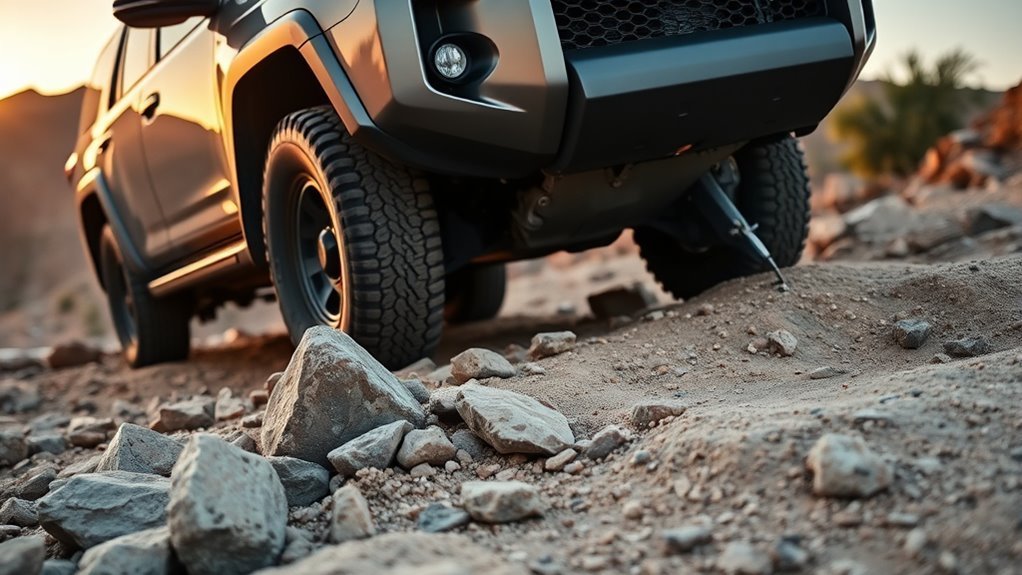
The factory front bumper and lower trim can be just as important as suspension height. On the 2025 TRD Off-Road, Toyota publishes a stock 19° approach angle even though the trim has 9.1 inches of ground clearance and 33-inch-class tires.
Air Dam Effects
Removing a low front air dam can increase the physical space between the front tire and the first part of the body likely to contact an obstacle. That is why owner measurements of the 2025 TRD Off-Road commonly show a much larger angle after the low front piece is removed.
However, Toyota does not publish a separate official TRD Off-Road approach angle with the air dam removed in its detailed 2025 specification table. Estimates around 30° or higher should therefore be treated as measurements of particular vehicles and methods, not as a Toyota factory specification.
- Use 19° when quoting Toyota’s stock TRD Off-Road specification.
- After any bodywork change, measure your own vehicle rather than assuming another trim’s number.
- Check tire pressure, vehicle load and suspension height before comparing measurements.
Bumper Design Impact
Bumper shape determines the point that meets a steep obstacle first. A shorter, higher front overhang lets the tire reach the obstacle sooner, which increases the usable approach angle even if axle clearance stays unchanged.
This explains why two 4Runners with similar tire diameters can have very different approach figures. TRD Off-Road is officially rated at 19°, while TRD Pro and Trailhunter reach 33°. The difference cannot be explained by one inch of ground clearance alone.
| Factory configuration | Published approach angle | Main takeaway |
|---|---|---|
| TRD Off-Road | 19° | Low front geometry limits the stock angle |
| TRD Pro / Trailhunter | 33° | High-clearance front geometry gives much more room |
Removal Trade-Offs
More clearance is useful, but a modification should be judged as a complete vehicle change, not only by the extra degrees it may create. Factory body pieces can contribute to airflow, protection and the intended road configuration.
Warning: Do not assume a lift, tire change or aftermarket bumper is safe simply because it improves an angle. Changes can affect tire clearance, handling, braking, lighting or driver-assistance hardware depending on the parts used.
If you modify the front end, confirm that fasteners, splash protection and nearby components remain secure. With an aftermarket bumper, also verify compatibility with the exact trim and any sensors or cameras fitted to your 4Runner.
Tire Size & Ride Height: Effects on Clearance and Angles
Larger-diameter tires can raise axle and body clearance, while suspension changes can raise parts of the body relative to the ground. Both may improve obstacle clearance, but neither guarantees the same approach, departure or breakover angle as another factory trim.
Toyota equips TRD Off-Road, TRD Pro and Trailhunter with 265/70R18 tires, commonly described by Toyota as 33-inch all-terrain tires. TRD Sport, Limited and Platinum use 265/55R20 tires in Toyota’s 2025 grade-specific wheel and tire data.
A tire’s theoretical increase in ground clearance is roughly half of its increase in overall diameter because the axle sits at the wheel center. Real clearance can differ because tire brands, tread depth, inflation pressure and vehicle load change the loaded radius.
Ride height affects front and rear contact geometry too, but bumper position still matters. That is why the safest comparison is the finished vehicle’s actual measurement rather than a simple “lift equals degrees” rule.
Pro Tip: Compare modifications using the same tire pressure, fuel/load condition and level measuring surface. Otherwise, small changes in tire deflection or suspension compression can make before-and-after angle measurements misleading.
How TRD Pro (FOX) vs Trailhunter (OME) Suspensions Change Angles
TRD Pro and Trailhunter share the same published 33° approach, 24° breakover, 24° departure and 10.1-inch ground-clearance figures. Their suspension differences are therefore more about how each trim manages terrain and load than one having a better published static angle.
- TRD Pro: Toyota fits TRD-tuned FOX QS3 three-way adjustable internal-bypass shocks with remote reservoirs. Toyota describes this setup as being aimed at improved high-speed off-road performance.
- Trailhunter: Toyota fits Old Man Emu forged monotube shocks with remote reservoirs. The factory tuning emphasizes off-road control and load-carrying capability for overlanding.
- TRD Off-Road: Bilstein monotube remote-reservoir shocks are used, with Toyota describing them as providing extended wheel travel and greater heat dissipation.
The suspension can change how a 4Runner behaves while the wheels move through their travel, but the published approach and departure numbers are static geometry specifications. Do not assume that FOX damping alone creates more approach angle than OME damping.
Measure Your 4Runner’s Approach and Departure at Home (Simple Steps)
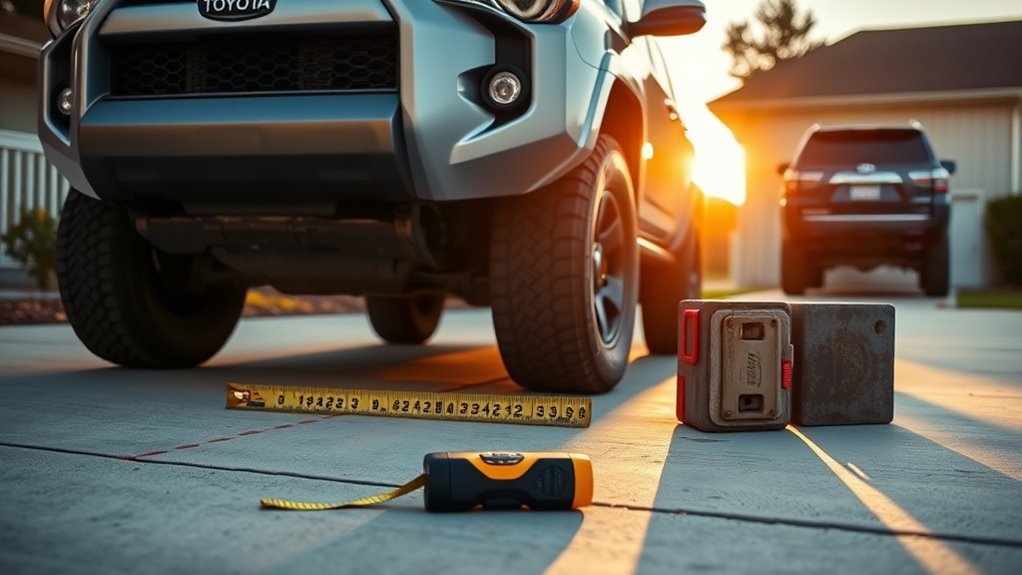
You can make a useful home estimate of approach and departure angles with the 4Runner parked on a flat, level surface. The idea is to reproduce the line from the loaded tire toward the lowest body point that would contact an obstacle first.
- Prepare the vehicle. Park on level pavement with normal tire pressure and the load you want to measure.
- Find the limiting front point. Look for the lowest forward bumper, valance, air dam or protection piece that an approaching slope would touch.
- Create the approach line. Hold a straightedge from the front tire’s ground-contact area toward that limiting point without pushing into the tire.
- Measure the angle. Use a digital angle gauge, protractor or reliable phone inclinometer to compare the straightedge with level ground.
- Repeat at the rear. Use the rear tire and the lowest rearward contact point to estimate departure angle.
For a closer engineering comparison, remember that formal vehicle definitions use the tire’s static loaded radius, not simply an unloaded tire circle. A home measurement is therefore best used to compare your own before-and-after setup rather than to dispute a manufacturer specification over one or two degrees.
Mods That Improve Angles Safely : Which Trims Become “High-Clearance” and Recommended Uses
The most useful modifications are the ones that address the part of the vehicle that is actually limiting you. A front-body clearance problem needs a different solution from a differential, center-breakover or rear-overhang problem.
- Front contact: bumper and lower-front-body geometry have the greatest direct effect on approach angle. Measure before replacing parts so you know what is actually touching.
- Underbody contact: additional tire radius can raise axle-related clearance, while a properly engineered suspension change may raise other chassis points. Protect vulnerable components with suitable skid protection where needed.
- Center high-centering: breakover depends on wheelbase, tire radius and the underside contact point. The 2025 lineup varies only from 23° to 24° in Toyota’s published data.
- Rear strikes: departure angle is 22° on SR5, TRD Sport, Limited and Platinum, and 24° on TRD Off-Road, TRD Pro and Trailhunter. Rear bumper or hitch hardware can become the practical contact point.
Do not label a modified Limited or TRD Off-Road as having TRD Pro geometry simply because its ground clearance increases. Measure the finished vehicle. The factory TRD Pro and Trailhunter remain the reference points in Toyota’s 2025 specifications at 33°/24°/24° with 10.1 inches of ground clearance.
Frequently Asked Questions
What are the 2025 4Runner approach and departure angles?
They range from 18° to 33° for approach and 22° to 24° for departure. SR5 is 18°/22°, TRD Sport, Limited and Platinum are 18°/22°, TRD Off-Road is 19°/24°, and TRD Pro and Trailhunter are 33°/24°.
Is a higher approach angle better off-road?
Yes, a higher approach angle generally lets the front tires reach a steeper obstacle before the front bodywork touches. It does not guarantee traction or safety, because surface conditions, tire grip, vehicle load and driver line choice still matter.
What is the departure angle of a 2025 4Runner?
The factory departure angle is either 22° or 24°, depending on trim. SR5, TRD Sport, Limited and Platinum are listed at 22°, while TRD Off-Road, TRD Pro and Trailhunter are listed at 24°.
What is the 2025 4Runner breakover angle?
Toyota lists a 23° breakover angle for SR5 and 24° for the other trim groups in its detailed 2025 data. Breakover angle matters when crossing a crest because too little clearance can leave the middle of the vehicle touching or high-centered.
Does removing the TRD Off-Road air dam give it a 33° approach angle?
Toyota does not publish an official post-removal TRD Off-Road angle in its detailed 2025 specification table. Removing low front bodywork can substantially improve the usable approach geometry, but measurements around 30–33° should be treated as configuration-specific estimates rather than a factory specification.
Which 2025 4Runner has the best factory off-road angles?
TRD Pro and Trailhunter have the best published factory approach geometry. Both are listed at 33° approach, 24° breakover and 24° departure with 10.1 inches of ground clearance.
Conclusion
The key 2025 4Runner geometry numbers are straightforward once you separate factory specifications from modified-vehicle measurements. TRD Pro and Trailhunter lead with a 33° approach angle and 10.1 inches of clearance, TRD Off-Road sits at 19° and 9.1 inches, and the remaining groups use 18° factory approach geometry.
Before changing tires, suspension or bumpers, identify whether approach, breakover, departure or underbody clearance is actually limiting your trail use. Then measure the finished setup under consistent conditions instead of assuming a modification gives you another trim’s published numbers.
Sources
- Toyota 2025 4Runner Sales Consultant Guide: factory approach, departure, breakover and ground-clearance figures by trim group, plus wheel and tire information.
- Toyota USA Newsroom — All-New 2025 Toyota 4Runner: production-grade suspension, tire and trim equipment details.
- Toyota USA Newsroom — Explaining Toyota’s Vehicle Geometry: Toyota’s explanation of approach, departure and ground-clearance concepts.
- Toyota USA Newsroom — 2025 4Runner Preliminary Reveal: the earlier 32° maximum approach figure and 24° departure figure used before Toyota’s later detailed specifications.

