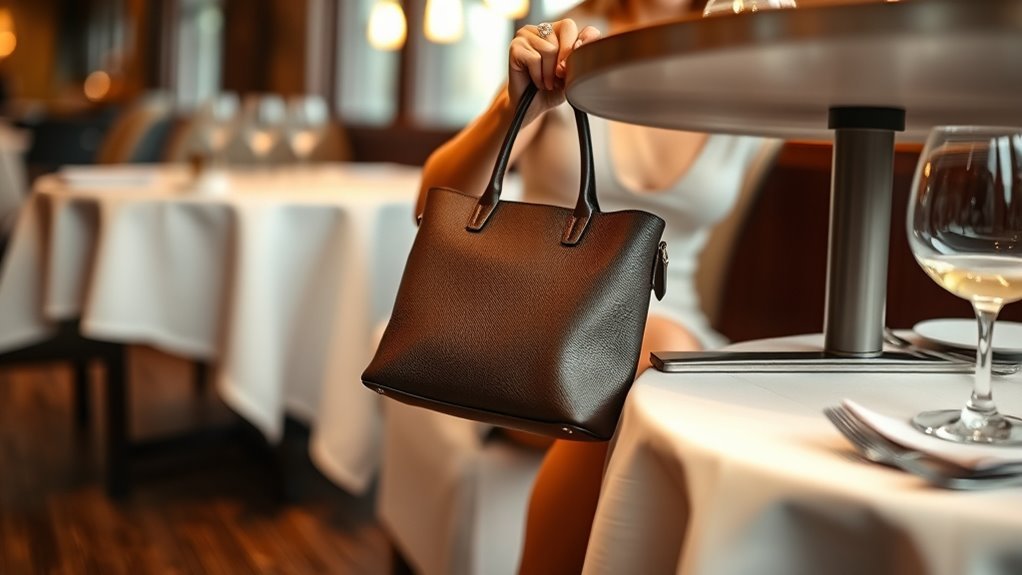
At a restaurant, keep your handbag off the table. A small bag goes on your lap, under your napkin, or behind you on the seat. A medium bag can sit on the seat behind your back, on an empty chair or on a bag hook. A large bag goes on the floor by your feet, with the strap looped around your foot or the chair leg. Avoid hanging a bag on the back of your chair, where it is easy to steal and blocks the aisle.
Why Handbag Placement Is Important for Dining Safety
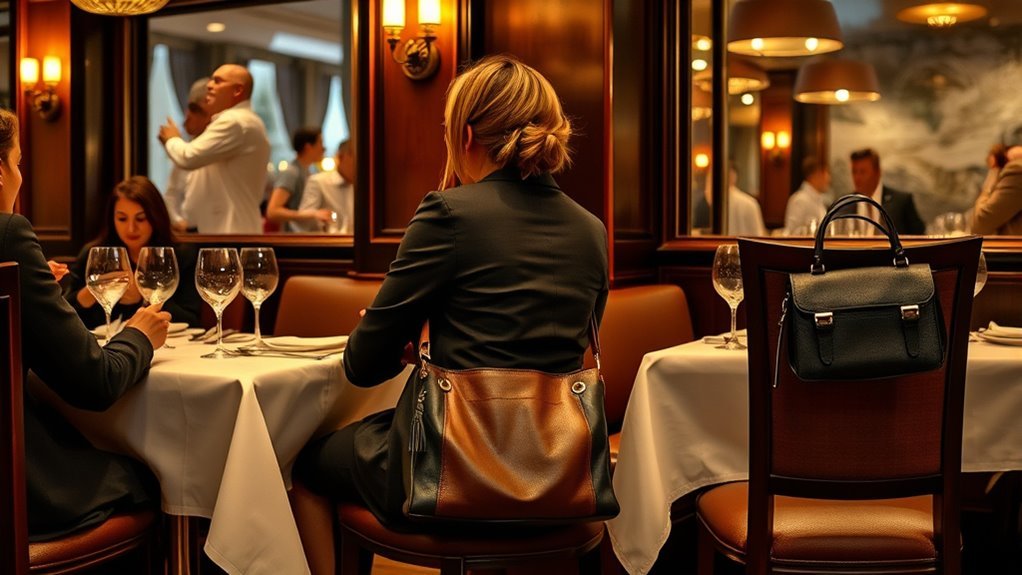
Where you put your bag affects both manners and security. Restaurants are a common place for bag theft, because people relax and stop watching their things. A bag hung on a chair back or left on a spare seat near the aisle can be lifted in a second. A bag on your lap, behind you on the seat or between your feet is much harder to take.
The table is the one place to avoid. Etiquette experts agree on this. A bag has been on floors, seats and counters, so it does not belong where food is served. It also takes up space and gets in the way of plates and glasses.
Good placement is also considerate. A bag in the aisle can trip a server who is carrying hot plates. Keep it within the space of your own seat.
Best Practices for Small and Medium Bags
A small bag or clutch is the easiest to manage. Put it on your lap and lay your napkin over it. It stays clean, out of sight and within reach.
If the bag is too big for your lap, place it behind you on the seat, between your back and the chair back. This works well with medium bags and chairs that have a solid back. Some etiquette experts prefer the lap or an empty chair, since a bag behind you can make you sit awkwardly.
In a booth, set the bag on the seat beside you, on the side away from the aisle.
An empty chair at your table is another good spot, as long as the restaurant is not crowded. Some restaurants offer a bag hook or a small stool for bags. Use it if it is offered.
A bag with a long strap can stay on your body. Slide a crossbody bag around to your lap so it does not hang into the aisle.
Tips for Handling Large Bags at Restaurants
A large tote or work bag will not fit on your lap or behind you. It has to go on the floor or on a spare seat.
The aim is to keep it close, out of the way of staff and as clean as possible.
If you know you are going somewhere formal, a smaller bag saves you the trouble.
Finding Suitable Floor Space
Look at the table before you sit down, and choose the seat with the most protected floor space.
Place the bag on the floor by your feet, under the table or against the wall. One etiquette tradition puts it on the floor to the right of your chair. Close the zip, and loop the strap around your foot or the chair leg so it cannot be pulled away unnoticed.
Keep the bag out of the aisle and away from the path the servers use. Stand it upright if you can, so that only the base touches the floor.
A wall seat or a corner table makes all of this easier, because one side is protected.
Keeping a Bag Clean on the Floor
Many people dislike putting a bag on a restaurant floor, and with good reason. Floors are dirty, and a pale leather base marks easily.
Do not use the restaurant napkin as a mat. A portable purse hook is a better answer. It rests on the table edge and holds the bag just below the tabletop, off the floor and within reach. Check that it grips well and that the bag is not too heavy for it.
You can also rest the bag on your own feet, or on a small foldable mat or dust bag that you carry for the purpose.
Bags with metal feet on the base keep the material off the floor. At home, wipe the base with a slightly damp cloth, or a dry brush for suede.
If none of this is possible, the floor is still better manners than the table.
Choosing Compact Bag Options
The simplest fix is to bring a smaller bag when you eat out.
A compact crossbody, a small shoulder bag or a clutch holds a phone, cards, keys and lipstick, and it fits on your lap. It is also easier to carry through a crowded dining room.
If you come straight from work with a large bag, ask whether the restaurant has a cloakroom for coats and bags. Take your wallet and phone with you to the table.
Carrying less also helps. A lighter bag is easier to place and less tiring to hold on your lap.
Common Handbag Don’ts to Avoid While Dining
A few habits are best avoided in any restaurant.
Do not put your bag on the table. It is unhygienic and crowds the place settings. A very small clutch at a casual bar table is the only common exception, and even then your lap is better.
Do not hang the bag on the back of your chair. It is out of your sight, easy to steal and likely to be knocked by staff and other guests. Do not leave it on your seat when you go to the restroom either. Take it with you.
Do not leave a bag in the aisle or pushed far under the table, where it can trip someone or be forgotten.
Avoid putting a bag on an empty chair when the restaurant is busy and seats are needed. Do not ask a server to look after it, since staff cannot take responsibility for valuables.
Choosing the Best Spot for Your Handbag
The right spot depends on the size of the bag and the seat you have. Use this quick guide:
- Small bags and clutches: On your lap under the napkin, or behind you on the seat.
- Larger bags: On the floor by your feet or against the wall, closed, with the strap around your foot or the chair leg.
- Places to avoid: The table, the back of your chair and the aisle.
Cultural Aspects of Handbag Etiquette
Customs differ from country to country, so it is worth watching what local diners do.
In a number of cultures there is a superstition that a purse on the floor brings bad luck with money. In parts of East Asia, including Japan, the floor is simply seen as too dirty for a bag. Hosts in these places may offer you a chair, a hook or a stool for it.
In Japan, many restaurants and cafes provide a basket beside or under the chair for bags and coats. Use it, and keep the bag off the table, since the base of a bag is considered dirty.
When you travel, follow the lead of the people around you. If the restaurant provides a hook, basket or stool, that is the right place for your bag.
Practical Tips for Maintaining Purse Security While Dining
Good manners and security point in the same direction. A bag that is close to your body is both polite and safe.
Here are some practical tips to follow:
- Keep it Close: Place your handbag on your lap or use a bag hook to make sure it’s accessible and safe from theft.
- Floor positioning: Put a larger bag between your feet or against the wall, zipped, with the strap looped around your foot or the chair leg.
- Choose Your Spot Wisely: Sit at tables away from entrances and high-traffic areas to minimize unwanted attention and improve security.
Frequently Asked Questions
Is It Rude to Put Your Purse on the Table?
Yes, in most settings. A bag has been on floors and seats, so etiquette experts advise keeping it off the table. Use your lap, the seat behind you, an empty chair or the floor.
Can You Hang Your Purse on the Back of Your Chair?
It is better not to. A bag on a chair back is out of your sight, which makes it an easy target for thieves, and it can get in the way of servers. Keep it on your lap, behind you on the seat or by your feet.
What Is Handbag Etiquette?
Handbag etiquette is the set of customs for carrying and placing a bag politely. At a restaurant it means keeping the bag off the table, out of the aisle and within your own space.
Where Do You Put Your Purse at a Restaurant?
A small purse goes on your lap under the napkin or behind you on the seat. A larger bag goes on an empty chair or on the floor by your feet, with the strap looped around your foot or the chair leg.
Conclusion
Restaurant handbag etiquette comes down to three rules. Keep the bag off the table, keep it out of the way of other people and keep it close to you. A small bag belongs on your lap or behind you, and a large one by your feet. A purse hook or a smaller bag makes the choice easier.

