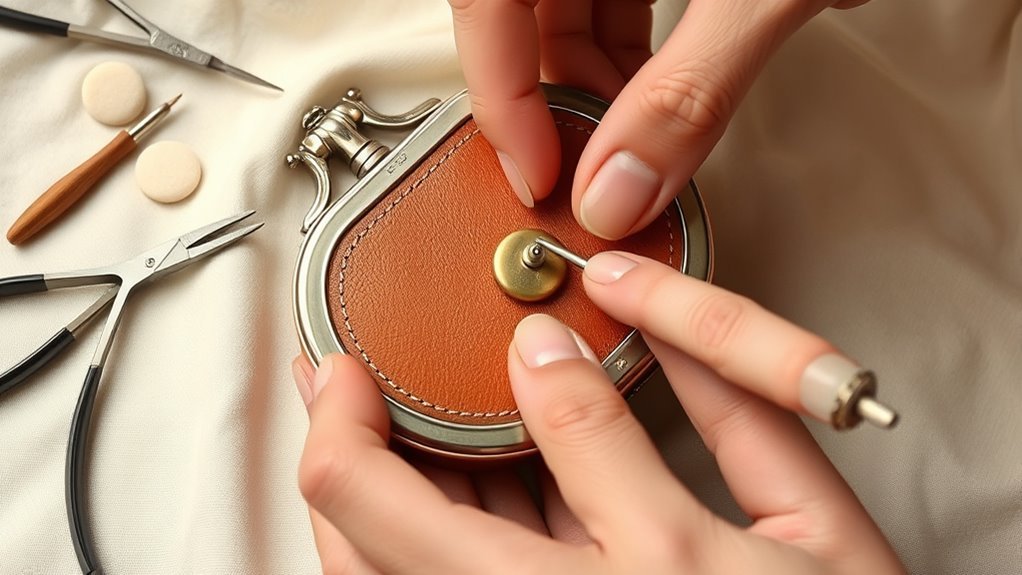
To fix a kiss lock purse frame without bending it, work on a flat surface, seat the fabric fully in the channel, use padded tools or a cloth between the metal and any pliers or clamps, and attach the frame by stitching through its holes or, for a glue-in frame, with a suitable adhesive. Let glue cure completely before you carry the bag.
What You Need for a Kiss Lock Frame
A kiss lock frame is the metal closure at the top of many small purses, with two sides that snap together at the center. A sturdy frame is the backbone of the purse, so start with a good one that matches your pattern. Gather what you need before you begin.
- The frame, and the bag body with its lining
- For a frame with holes: strong thread, such as upholstery or heavy polyester thread, and a needle that passes easily through the holes
- For a glue-in frame: a flexible adhesive suited to your fabric and metal, such as a contact cement or a purse-frame glue
- Paper clips or small clamps with a cloth buffer, and a cocktail stick or toothpick for spreading glue
- A small flat screwdriver or an awl, scissors and pliers with taped jaws
How to Seat the Fabric in the Frame
Cut the fabric so that it fits the channel in the frame, and check the fit before you glue or sew. The edge should go all the way into the groove, with no gaps and no extra bulk. If the fabric is thick, trim the seam allowance a little and clip curves so that it sits flat. Press the fabric in gently but firmly, working along one side at a time, and keep the pressure even, so that the metal does not twist.
Keep the Frame Straight While You Work
Hold the frame on a firm, flat surface. Support both halves so they stay even, and use a strip of cardboard or a folded piece of cloth to keep the opening aligned. When you are sewing, use strong thread and small, even stitches. Check the alignment often by closing the frame, and fix small errors before you finish. Frames bend when force is applied unevenly, so work slowly.
Clamp the Frame Without Bending It
If you need to squeeze the frame, for example when closing the edge of the channel, use pliers with taped or padded jaws, or place a soft cloth between the pliers and the metal. Apply pressure in small steps and check your progress from both sides. Clips or clothespins are enough for holding a glued edge, and they are gentler than a metal clamp. If the frame begins to bend, stop, release it and reset it by hand on a flat surface.
Sewing a Kiss Lock Frame With Holes
Frames with holes are the most secure, because stitches hold the fabric mechanically.
- Mark the center of the frame and the center of the bag opening, and match them.
- Start at the center, and work outward to one end, then do the other side. This keeps the fabric evenly distributed.
- Use a backstitch or a whip stitch through each hole, pulling the thread snug but not so tight that it puckers the fabric.
- Go through the holes a second time for added strength if the frame carries a strap.
- Secure the thread at each end with a knot or a few small backstitches, and trim.
Gluing a Kiss Lock Frame Without Holes
Frames without holes are made to be glued in. They are generally intended for light bags and are not meant to carry a heavy load.
- Clean the inside of the channel and the edge of the fabric, to remove dust and oil, and let them dry.
- Apply a thin, even layer of adhesive in the channel, using a toothpick to reach corners. Too much glue squeezes out and shows.
- Press the fabric into the channel, using a flat tool or a blunt awl.
- Hold it with clips, and keep the frame flat while it sets.
- Let the glue cure for the time on the label, which is often many hours, before you use the bag.
Test the glue on a scrap first to make sure that it bonds to your fabric and does not stain it. Follow the label for ventilation and safety.
Combine Glue and Stitching for Tough Frames
If the frame has holes and the bag will carry weight, or if a strap attaches to the frame, do not rely on adhesive alone. Add glue to hold the fabric in position and sew through the holes for strength. Glue alone can let go under repeated stress, whereas stitches share the load. If your frame has no holes and a strap attaches to the bag, attach the strap to the fabric body of the bag, and not to the frame.
Fix Loose, Crooked or Tight Frames
- Loose frame: the fabric may be too thin or the channel too wide. Add a thin strip of fabric or interfacing to thicken the edge, then reglue or restitch.
- Crooked frame: remove the fabric and reseat it, balancing the folds on each side. Match the center marks.
- Tight frame: trim the seam allowance so that the fabric is not too thick for the channel.
- Clasp does not meet: check that both halves are the same height, and that the fabric is not pulling one side down.
Troubleshoot the Installation
If the fabric will not stay in the channel while you work, hold it with small clips along the edge, and push it in with a thin, blunt tool. If the frame bends, flatten it by hand on a firm surface, and never hammer it. If the lining bunches, see why handbag lining bunches up. Stiffening the bag body with a soft layer can make installation easier, and bag foam stabilizer explained shows how it works.
Test the Frame
Close and open the frame several times. It should click shut with firm contact, and release with a pinch. Fill the bag with your usual items and test it again, and check that the stitches or glue are holding. If you plan to make or repair other styles, see how to make a frame clutch and what a frame clutch is, and for other closures, see purse closure types.
Frequently Asked Questions
What Is a Kiss Lock Frame?
It is a metal purse closure with two hinged halves that snap together at a pair of small balls, which are pinched to open it. It is common on coin purses and small clutches.
How Do I Stiffen a Floppy Purse?
Add a layer of fusible fleece, heavy interfacing or a foam stabilizer to the bag panels. Test a scrap first, so that the bag does not become too stiff to fit the frame.
How Do I Install a Purse Snap Closure?
Mark the position on both sides, make the holes, push the snap through, fit the back piece and press the prongs flat or tighten the post. Reinforce thin fabric first.
Conclusion
A kiss lock frame is easy to fix if you keep it flat, use padded tools and choose the right attachment method. Sew through the holes where they exist, glue carefully where they do not, and let everything set fully before you use the bag.
