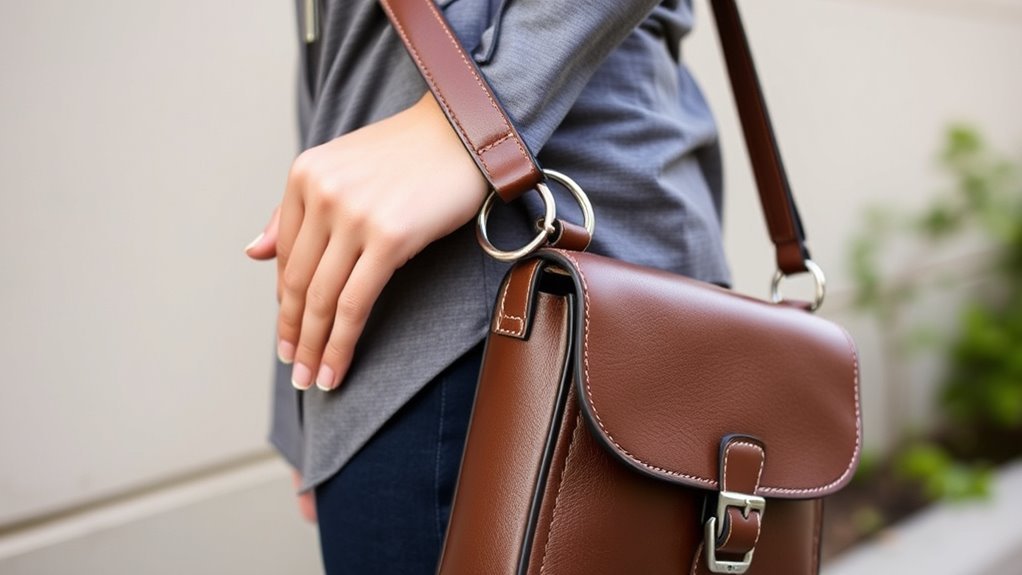
To convert a shoulder bag to crossbody carry, clip a longer strap to the bag at two solid attachment points. Use the metal rings that hold the original strap, or D-rings on the sides. Pick a strap at least 1 inch wide with swivel clips that fit those rings. Set the length so the bag rests at your hip. Do not clip onto zipper pulls or thin decorative loops, because they are not built to hold weight.
Choose the Right Shoulder Bag
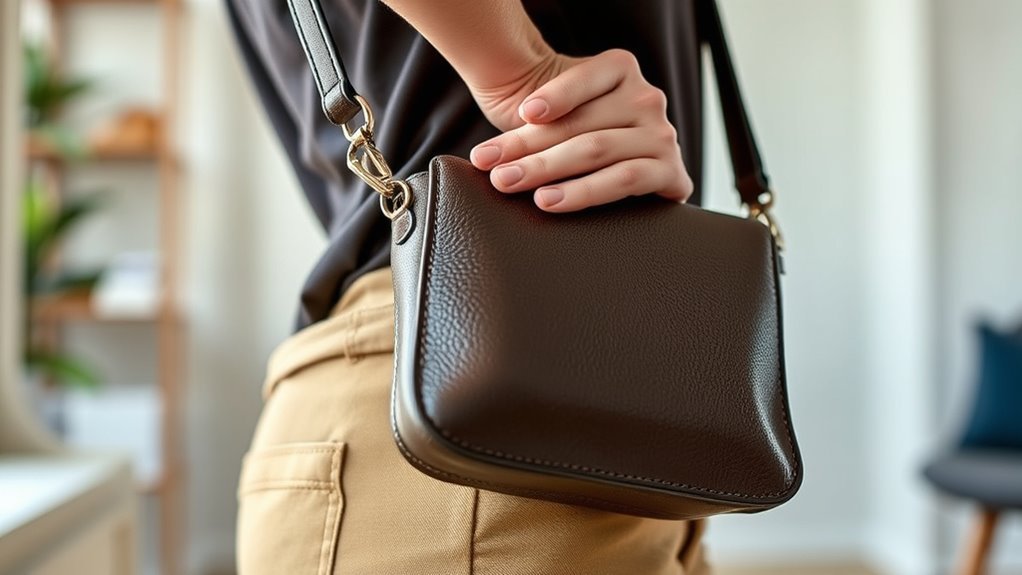
Not every shoulder bag converts well. Crossbody wear pulls on the attachment points at an angle, so the bag needs strong ones.
Small and medium bags work best. A large, heavy bag swings and digs in when worn across the body. A bag with some structure also sits flatter against the hip.
Look at where the current strap joins the bag. Metal rings held by stitched and riveted leather tabs are a good sign. Thin fabric loops or glued tabs are not.
Check the weight too. If the bag is already heavy when full, lighten the load before you hang it from a single long strap.
Pick a Safe Crossbody Strap
Choose a strap at least 1 inch wide in leather, nylon webbing, or canvas. A thin strap or chain cuts into the shoulder when the bag is full.
An adjustable strap is worth it, because the right length changes with your height and your coat. A wider strap of 1.5 to 2 inches is more comfortable for heavier bags.
Check the clips. They should be solid metal with a spring gate that snaps shut.
Strap Strength Matters
The strap carries the whole bag, so build quality matters. Look for even stitching where the strap folds around its hardware, and clips that feel heavy for their size.
Leather and nylon webbing both hold up well. Avoid straps that already show fraying or cracked edges. Width helps comfort, since a wider strap spreads the load over more of the shoulder.
For length, most adults need a strap of about 45 to 55 inches from end to end. That gives a drop of roughly 20 to 25 inches, which puts the bag near the hip. If the maker lists a weight limit, stay under it.
Straps sold for handbags usually come in standard clip sizes, so replacing one later is easy.
Match Attachment Hardware
Next, find the attachment points on your bag. There are three common setups.
Some bags have D-rings or O-rings on the side panels, often hidden inside the top edge. These are made for an extra strap. Others have a shoulder strap that clips on, so you can swap it for a longer one. On the rest, the strap is sewn on, and its base rings are the only option.
If the strap is sewn to rings at each end, you can clip a long strap to those same rings. If there are no rings at all, do not improvise. A leather repair shop or cobbler can add two D-ring tabs.
Clip to both sides of the bag, not to one side or one handle. Two points keep the bag level and share the load.
Never clip a strap to a zipper pull, a decorative charm loop, or a thin chain. These parts can snap or tear out of the bag.
Two strong rings, one on each side, is the setup to aim for.
Choose Connectors That Fit Your Hardware
The clip has to fit the ring. Measure the inside width of the ring on your bag, then choose a clip whose gate opens wide enough to pass over it.
Swivel snap hooks and lobster clasps are the two usual types. Both turn freely, which stops the strap from twisting. Choose metal clips. Plastic ones are fine for light nylon bags only.
Match the metal color to the bag hardware, such as gold with gold, so the new strap looks like it belongs.
Test Connector Fit
Before you rely on the new setup, test it at home. Clip the strap to both rings and check that each gate has closed fully.
The clip should move freely on the ring without grinding against the leather tab. If it rubs the bag, the clip is too large or the ring is too small.
Fill the bag with what you normally carry and lift it by the strap. Give it a few firm tugs. Watch the tabs that hold the rings. If the stitching stretches or the tab pulls away, stop and do not use that point.
Attach the Strap Without Damaging Hardware
Attach the strap with care so you do not scratch the hardware. Open the clip fully before you slide it onto the ring. Do not force it.
Make sure both clips face the same way and the strap is not twisted. Uneven tension pulls the bag to one side and strains one tab more than the other.
If the bag still has its short shoulder strap, tuck it inside or let it fall flat against the bag. Take it off if it is removable.
Check the clips each time you head out. A gate that has not closed is the most common reason a bag drops.
Adjust the Crossbody Length
Now set the length. Put the strap over one shoulder and across your chest. Adjust the buckle until the top of the bag sits at or just above your hip bone.
A shorter strap holds the bag higher and closer, which is steadier in crowds. A longer strap is easier to reach into but swings more.
The strap should lie flat and feel secure, not tight. Push the buckle prong fully through its hole so the length cannot slip.
Adjust for your build and your clothes. You may need one more hole over a winter coat.
Slide any loose strap end through its keeper loop so it does not flap.
Check the Fit and Feel
With the length set, check how the bag wears. It should rest against your hip without pinching your neck or shoulder.
Pack it with your usual items. The bag should hang level. If it tips forward or back, the load is uneven or one clip sits on the wrong ring.
Walk for a few minutes. Turn, sit, and stand, and watch for sliding, bouncing, or twisting.
Make sure the clips do not catch on your clothes. If the strap digs in, a wider strap or a shoulder pad will help.
Protect the Bag Hardware
Metal clips on metal rings will wear the plating over time. To slow that down, choose clips with a smooth finish and take the strap off when you store the bag.
If you had D-ring tabs added, check the rivets or stitching every few weeks at first. A loose rivet should go back to the repair shop before it tears the leather.
Look over all attachment points now and then. Stop using the long strap at the first sign of cracked leather, stretched stitching, or a bent ring.
Wear Your Bag Hands-Free
Worn crossbody, the bag leaves both hands free in shops, on transit, and in crowds. The strap crosses your torso, so the bag cannot slide off your shoulder.
Many people also find it more comfortable than one-shoulder carry, since the load is shared across the body.
Wear the bag toward the front of your hip in busy places. You can see it there and keep a hand on it.
Keep the zip or flap closed and facing your body.
Switch sides from time to time, so the same shoulder does not carry the weight all day.
When you want the original look back, unclip the long strap and carry the bag on your shoulder again.
Frequently Asked Questions
How to Add Shoulder Straps to a Bag?
Find two strong rings or D-rings on the bag, one on each side. Clip on a strap with swivel hooks that fit those rings. If the bag has no rings, a leather repair shop can add D-ring tabs.
What Is the Difference Between a Handbag and a Shoulder Bag?
Handbag is the general word for any bag carried by hand or on the arm. A shoulder bag is one type of handbag, with a strap long enough to hang from the shoulder.
Conclusion
Converting a shoulder bag to crossbody carry comes down to three things: strong attachment points, a wide strap with clips that fit, and the right length. Test the setup at home with a full bag, and check the clips and tabs regularly. If the bag has no solid rings, have them added instead of improvising.