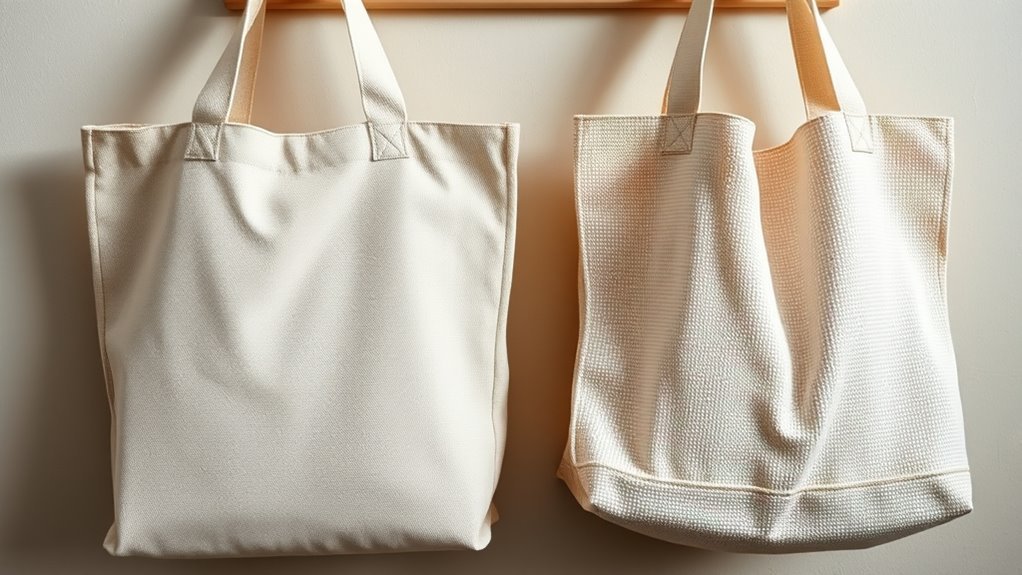
Fabric weave directly affects how durable your tote bag is and how much it stretches. A tight plain weave gives you the most stability and shape retention, while twill adds better abrasion resistance and a bit more flexibility. Basket weave can be strong, but it may stretch more if it isn’t dense enough. Canvas or denim in a 10–12 oz weight usually performs best. Add lining or interfacing, and you’ll boost strength further, with more details ahead.
What Makes Tote Bag Weave Matter?
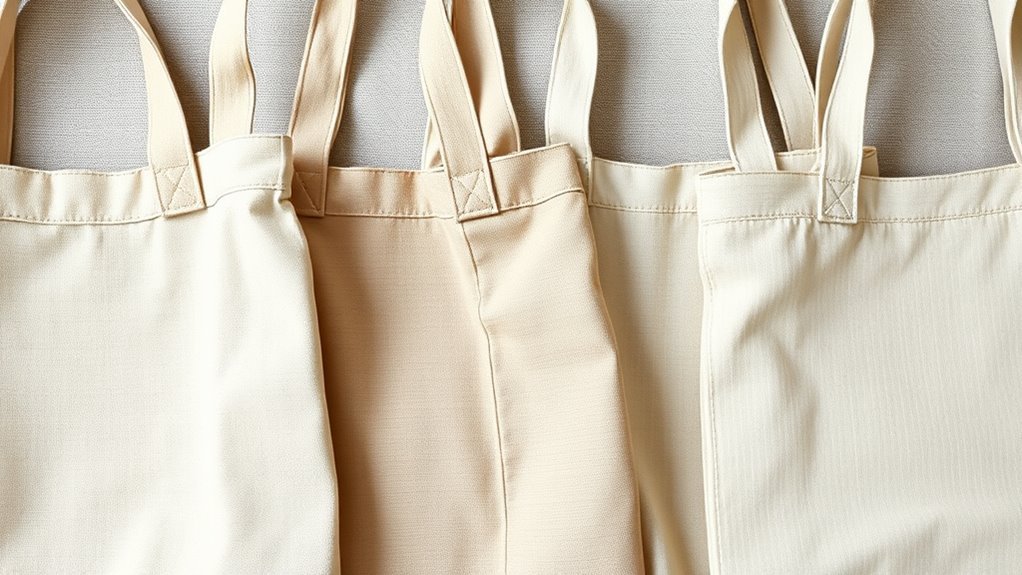
The weave of a tote bag matters because it directly determines how the fabric handles stress, abrasion, and load.
When you evaluate weave selection, you’re choosing how well the cloth resists tearing, distortion, and repeated use. Tighter constructions usually raise tensile strength, so your tote can carry heavier contents with less failure risk. Higher thread count often supports that advantage, because more yarn intersections distribute force more evenly across the surface.
You also need to assess stretch behavior: a weave that controls deformation helps the bag keep its shape under tension, while a more fluid structure can trade load-bearing capacity for drape. For practical use, that tradeoff matters.
If you want fabric longevity, you should match weave structure to the demands you place on the bag. A well-chosen weave doesn’t just survive abuse; it preserves performance, letting you move with confidence and autonomy.
Plain Weave vs Twill vs Basket Weave
When you compare plain weave, twill, and basket weave, you’re really comparing three different ways fabric manages load, abrasion, and shape retention.
Plain weave gives you a tight crisscross structure that resists deformation, so the plain weave benefits are clear when you want a stable tote with minimal stretch.
Twill weave uses diagonal floats to add drape and flexibility, and it usually handles abrasion better than plain weave, but the twill weave drawbacks include slightly more elasticity under weight.
Basket weave goes further by pairing yarns in warp and weft, creating a thicker, textured matrix with high strength and strong stretch resistance.
- Plain weave: maximum stability, low stretch.
- Twill weave: better wear resistance, moderate give.
- Basket weave: robust structure, heavy-load readiness.
If you want a bag that holds its form while carrying changing loads, you can read these structures as different engineering choices, not just aesthetics.
Best Woven Fabrics for Tote Bags
Canvas and denim are among the best woven fabrics for tote bags because their dense structures deliver strong abrasion resistance, reliable load support, and long-term durability.
When you compare fabric composition, you’ll see both materials handle repeated carry cycles without collapsing under weight. Plain weave canvas gives you a stable shell, while twill denim adds controlled flexibility and dependable strength, so your tote keeps its form during daily use.
Canvas stays structured, while denim adds flexible strength, helping your tote hold shape through repeated daily use.
Aim for 10oz to 12oz fabric for a balanced feel; it’s heavy enough for hauling books, groceries, or tools, yet still manageable in hand. Higher thread count improves tear resistance, helping you avoid premature rips.
If you need moisture protection, choose woven fabrics with water-resistant coatings for outdoor conditions. You can also find eco friendly options in recycled cotton canvas or low-impact denim, letting you select durable materials that support practical freedom and responsible use.
How Tight Weaves Affect Strength
Because tighter weaves leave less space between fibers, they boost tensile strength and help a tote bag hold heavier loads without stretching or deforming. When you choose canvas or oxford, you’re selecting a denser fabric density that distributes stress more efficiently across the weave. That structure reduces fiber slippage, so your bag resists abrasion, tearing, and shape loss under repeated use.
- Higher thread count increases load-bearing capacity.
- Compact yarn spacing limits stretch under tension.
- Dimensional stability keeps the bag’s form after washing.
You’ll also notice tighter weaves keep performance consistent in demanding conditions. Their dense construction can slow moisture penetration, which matters when you carry tools, produce, or field gear.
For you, that means more autonomy: a tote that stays reliable, maintains its geometry, and endures hard use without surrendering to strain. Tight weaves don’t just feel robust; they engineer resilience into every square inch, giving you a durable, liberation-ready carry solution.
Why Lining and Interfacing Help
Adding a lining and interfacing gives your tote a structural advantage that plain fabric alone can’t match.
Lining and interfacing give your tote the strength, shape, and durability plain fabric can’t provide.
When you add cotton lining, you create a secondary shell that resists stretch, distributes stress, and improves durability under repeated loading. Those lining benefits matter because they also block abrasion from keys, bottles, and other sharp items, reducing wear at contact points.
Iron-on interfacing increases stiffness, so your bag keeps its silhouette instead of sagging when you carry heavier contents. Different interfacing types let you tune support: lighter grades preserve flexibility, while firmer grades maximize shape retention.
You also gain a cleaner interior and a more polished exterior finish, with room for contrast color or pattern choices that express your style without sacrificing function.
Together, lining and interfacing extend service life, making your tote dependable for daily use, work, and heavy carrying with less failure, less distortion, and more freedom in how you move.
Best Weaves for Everyday Tote Bags
Once you’ve added lining and interfacing, the outer fabric weave becomes the next major factor shaping tote performance. You can read tote behavior through fabric characteristics and weave patterns, then choose the structure that matches your use.
- Plain weave gives you a stable, uniform surface. It balances durability and flexibility, so it works well for daily carry without excess bulk.
- Twill weave uses diagonal ribs to increase strength and pliability. You get better load tolerance, and the bag keeps its form under heavier use.
- Basket weave interlaces multiple yarns, creating a textured, robust face. It resists abrasion well, which helps when you want a bag that serves freely and endures repeated handling.
If you expect rough treatment, ripstop weave adds grid reinforcements for tear resistance.
Satin weave can look refined, but it’s less suitable when you need hard-wearing everyday utility.
How to Prevent Tote Bag Stretching?
To keep a tote from stretching, you need to control both fabric choice and structural support. You’ll get better load stability when you select 10oz–12oz cotton canvas, because denser weave resists elongation. Reinforce handles and seams with double or triple stitching, so stress doesn’t migrate into the body. Add a cotton lining and iron-on interfacing to stiffen the shell and preserve geometry.
| Method | Effect |
|---|---|
| Heavy canvas | Limits stretch |
| Stitch reinforcement | Protects joints |
| Cotton lining | Adds structure |
| Interfacing | Increases stiffness |
| Load control | Reduces strain |
You also need disciplined weight distribution: place dense items low and centered, not at one side. For fabric care, avoid harsh washing and high heat, which can relax fibers and weaken support layers. Don’t overload the bag; excess mass turns a free, durable tote into a distorted one.
Frequently Asked Questions
What Is the Most Durable Fabric for Bags?
Canvas is your toughest choice; you’ll find canvas options outperform most fabrics in fabric comparisons because their tight weave resists tearing, supports heavy loads, and keeps structural integrity, especially when you choose heavier cotton canvas.
What Are the Downsides of Woven Fabric?
Like a beautifully rigged sail with hidden snags, woven fabric can fray, resist stretch, absorb moisture, and add weight. You’ll face woven fabric limitations and higher cost, which can weaken long term performance.
How to Make a Tote Bag More Sturdy?
Use 10–12oz canvas, add reinforced stitching at handles and seams, and interface the lining. You’ll reduce stretch, boost load capacity, and keep shape. Apply fabric treatments for abrasion resistance and longer-lasting structure.
Does Woven Fabric Stretch?
Yes, woven fabric stretches only slightly; you’ll notice limited give because its interlaced structure boosts stretch resistance. You can expect woven fabric properties to prioritize stability, so your tote won’t elongate much under load.
Conclusion
You can see that weave drives tote durability. Plain weave gives you balanced strength, twill adds tough, flexible resilience, and basket weave offers roomy structure but less firmness. Tighter weaves resist abrasion and stretch, especially when you pair them with lining and interfacing. For everyday use, choose dense, stable fabrics and avoid overloading your bag. With the right weave, you’ll protect performance, preserve shape, and prevent premature pouch-like sagging.