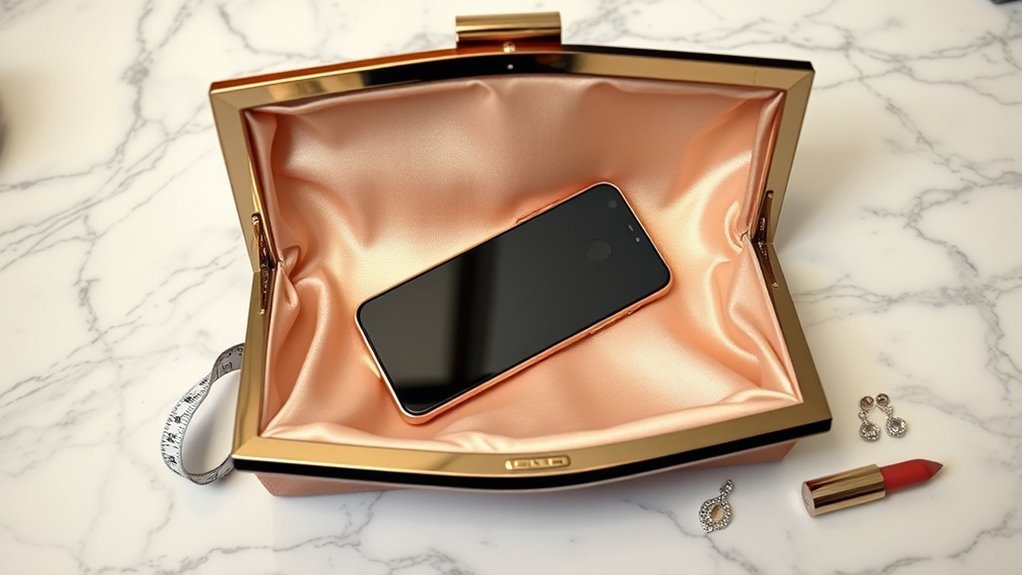
To tell if a phone will fit in a clutch with its case on, measure the phone in its case and compare it with the inside of the clutch, not the outside. You need three numbers: height, width, and thickness, including the camera bump and any grip on the back. The clutch opening must be wider than the phone, and the interior should be about half an inch longer than the phone is tall. If it is close, test with a piece of cardboard cut to the size of your phone.
How to Check If Your Phone Fits in a Clutch
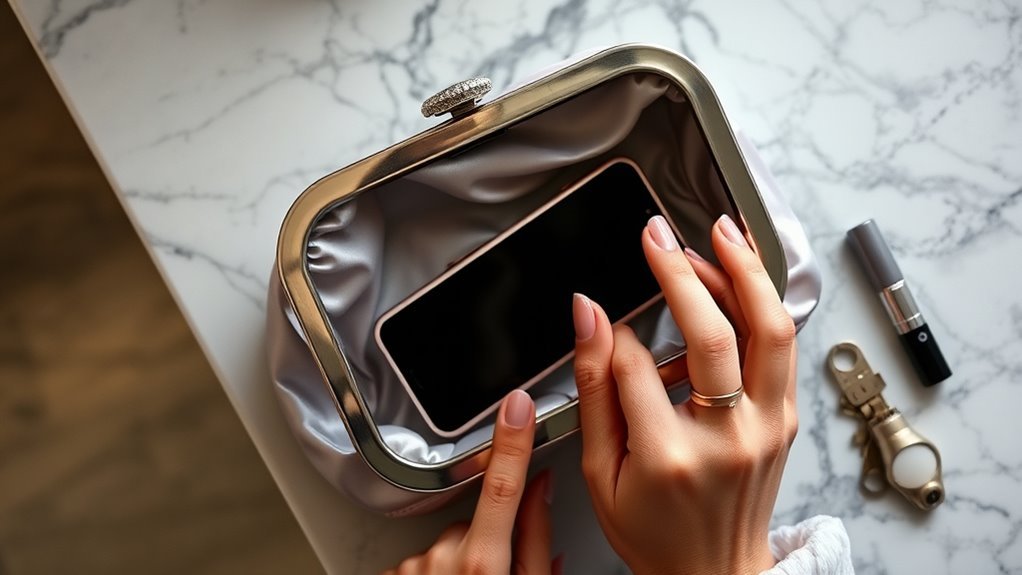
Phones have grown, and many clutches have not. A quick check before you buy, or before a night out, saves a lot of frustration.
The check has two parts. Measure the phone as you actually carry it, in its case. Then measure the usable space inside the clutch.
Thickness matters as much as length. A slim envelope clutch may take the length of a phone but bulge or refuse to close once a thick case goes in.
If you are in a shop, simply try it. Slide your phone in, close the clutch, and check that the clasp or zip shuts without force.
If you are buying online, the measurements below tell you what to compare.
Measure Your Phone Dimensions Accurately
Lay the phone, in its case, on a table. Measure the height from top to bottom and the width from side to side with a ruler.
Then measure the thickness at the thickest point. That is usually the camera bump, or a grip, ring, or wallet pocket on the back.
A case adds more than you might expect. A slim case adds only a little on each side. A rugged or wallet case can add a quarter inch or more to every dimension.
Phone sizes vary a lot between models, and the screen size in the name is a diagonal, not the height. Always go by your own measurements.
Write the three numbers down. These are the figures to compare with the clutch.
Understand Clutch Size Specifications
Clutch listings usually give outside dimensions as length, height, and depth.
The inside is smaller. Lining, padding, and seams take up space, so subtract about half an inch from the listed length and height as a rough guide. Framed clutches lose more, because the metal frame narrows the opening.
The opening is the tightest point. A kiss-lock or frame clutch opens to less than its full width, and a zip stops short of each end.
Clutch Size Guidelines
Clutches come in a wide range of sizes. Small evening clutches can be too short for a large phone in a case. Larger envelope clutches take almost any phone.
As a rule of thumb, the inside length should be at least half an inch more than the height of your phone in its case. That leaves room to slide it in and out.
Depth is the other limit. A flat clutch with no gusset has little room for a thick case plus cards, keys, and a lipstick.
A clutch with a gusset, which is a folded panel at the sides or base, opens wider and holds more.
Phone Dimensions Comparison
Compare your numbers side by side. The phone height should be less than the inside length, the phone width should be less than the opening, and the thickness should leave room for the other things you carry. If a listing gives no inside measurements, ask the seller, or check the reviews for mentions of your phone model.
Evaluate Your Phone Case’s Bulk
The case is often what turns a good fit into a tight one. Look at how thick yours is.
Extras add bulk. A grip, a ring holder, a kickstand, or a card pocket on the back makes the phone much thicker at that point.
Material matters too. A soft silicone case grips the lining and is harder to slide in and out. A smooth hard case slides more easily.
Always measure with the case and any extras on, since that is how the phone will go into the bag.
Compare Measurements to Clutch Size
Now compare. Take the height, width, and thickness of the cased phone and set them against the inside length, opening width, and depth of the clutch.
If the phone is longer than the inside, check the diagonal. A wide clutch can sometimes take a phone at an angle, though it uses up more of the space.
For a close call, make a template. Cut a piece of stiff cardboard to the height and width of your cased phone, and stack more cardboard to match the thickness. If the template goes in and the clutch closes easily, the phone will fit.
Remember the rest of your things. A clutch that only just holds the phone has no room for cards, keys, or lipstick.
Tips for a Secure Fit in Your Clutch
A phone that fits should also stay put and come out easily.
If the fit is tight with the case on, you can carry the phone without its case for the evening. Weigh that against the risk of dropping an unprotected phone.
A slim case is a good middle path. It protects the phone and takes up far less room than a rugged one.
Put the phone in first, flat against the back wall of the clutch, and pack the smaller items in front of it.
Some clutches have a phone pocket in the lining. Check its size too, since older designs have pockets made for smaller phones.
Keep keys and anything sharp in a small pouch, so they do not scratch the screen.
Make sure the clutch closes without pressure on the phone. A clasp forced shut over a phone can crack a screen or strain the frame of the clutch.
What to Do If Your Phone Doesn’t Fit?
If the phone does not fit, you have three options.
Change the case, change what you carry, or change the bag.
Start with the cheapest fix and work up.
Assess Alternative Cases
First, try a slimmer case. Moving from a rugged case to a thin one frees up space in every direction.
Remove grips and ring holders that stick out. Some of them twist off or collapse flat.
If the phone still will not fit, choose a different bag for it. A wristlet, a larger envelope clutch, or a small crossbody will hold a big phone with ease.
A phone crossbody or a phone pouch on a strap is another choice. You carry the phone separately and keep the small clutch for cards and lipstick.
Consider Phone Size Options
Do not force a phone into a clutch that is too small. It strains the seams and the clasp, and it can damage the phone.
Run through this list:
- Measure your phone. Include the case and any grip.
- Opt for a slim case or ditch the bulky one to minimize case thickness.
- Explore clutches designed for larger smartphones or consider a stylish wristlet.
- Check user reviews for compatibility insights on similar models.
Final Thoughts on Finding the Right Clutch
When you shop for a new clutch, take your phone measurements with you.
Keep these points in mind:
- Measure your phone: Measure height, width, and thickness with the case on.
- Explore clutch styles: Look for adjustable features like removable straps or expandable compartments.
- Read user reviews: Community insights can reveal practical experiences with various designs.
Leave a little spare room. Your next phone or case may well be bigger than the one you have now.
A clutch that fits your phone easily is one you will actually use.
Frequently Asked Questions
Should You Take the Case Off to Fit a Phone in a Clutch?
Only if you are comfortable carrying the phone unprotected. A slim case is the safer choice. If you do take the case off, keep the phone apart from keys and other hard items.
How Do You Measure the Inside of a Clutch?
Open the clutch and measure the inside length along the base, the height from base to opening, and the depth from front to back. Then measure how wide the opening actually spreads, since that is often the tightest point.
Conclusion
Measure the phone in its case, measure the inside and the opening of the clutch, and allow about half an inch of spare length. If it is close, test with a cardboard template. If it will not fit, switch to a slimmer case or a slightly larger bag.

