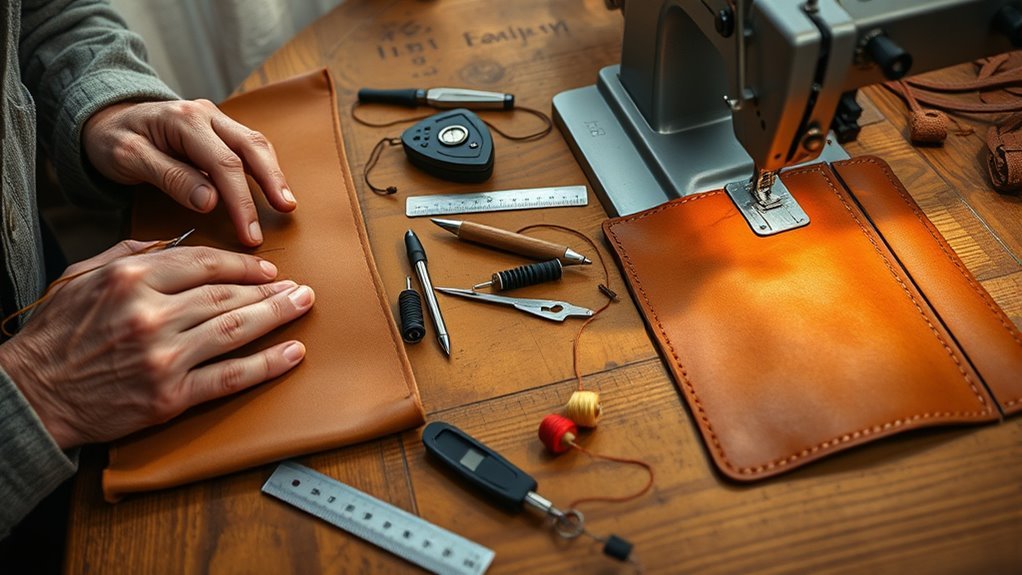
Hand stitching and machine stitching can both make a strong leather bag. Hand stitching uses the saddle stitch, in which two needles pass through every hole. It is slow and costly, but it holds even if one thread breaks. Machine stitching uses a lockstitch. It is fast, even and strong enough for nearly all bags, which is why most bags, including many luxury ones, are machine sewn. The quality of the work matters more than the method.
Why Hand Stitching Matters for Leather Bags: Craftsmanship and Techniques
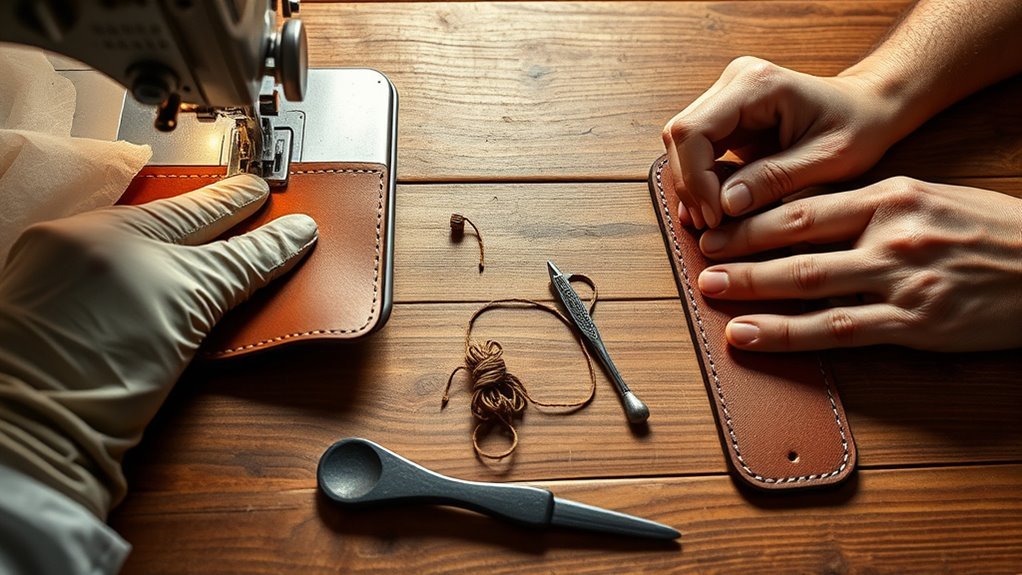
Hand-stitched leather is sewn with the saddle stitch. One length of thread carries a needle at each end. Both needles pass through each hole from opposite sides, so the thread forms two complete lines of stitching in one seam. If one side wears through, the other still holds.
The work is slow. The maker marks the stitch line, punches or pierces each hole, and pulls every stitch tight by hand. A single bag can take many hours of stitching alone, which is the main reason hand-sewn bags cost more.
The basic tools are simple: pricking irons or stitching chisels to mark even holes, an awl, two blunt harness needles, waxed thread and a clamp called a stitching pony to hold the work.
Hand stitching usually uses thick, waxed thread. The wax helps the thread grip and seals the holes a little. The stitches sit at a slight slant, which gives hand-sewn seams their characteristic look.
What You Should Know About Machine Stitching
Machine stitching is how the great majority of leather bags are made. An industrial machine sews a lockstitch, in which a top thread and a bobbin thread loop around each other inside the leather.
It is fast and very consistent. Stitch length and tension stay the same from start to finish, and a good machine handles thick layers easily. Done with strong bonded thread, it is durable enough for daily use.
If you sew leather on a machine yourself, use a leather needle, bonded nylon or polyester thread and a longer stitch. A walking foot or a roller foot helps the leather feed evenly.
Test on a scrap of the same leather first. Needle holes in leather are permanent, so mistakes cannot be unpicked without leaving marks.
Machine stitching has one weakness. In a lockstitch, each thread depends on the other. If a thread breaks and the loose end is pulled, a length of seam can come undone. Good makers lock the ends and reinforce stress points to prevent this.
Comparing Durability: Hand vs. Machine Stitching
On paper, the saddle stitch is the more secure seam. Each thread passes fully through every hole, so a broken thread does not let the seam open.
In practice, a well-made machine seam with strong thread also lasts for many years. Most seam failures come from worn thread at stress points, poor tension or weak leather, not from the type of stitch.
Hand stitching has a real advantage in tight or awkward places, such as handle attachments and curved gussets, where a machine cannot reach well. Many high-end makers combine the two: machine stitching on long straight seams and hand stitching where strength and access matter most.
Hand stitching is also easier to repair in small sections. A few broken stitches can be resewn through the original holes without taking the bag apart.
How Can You Identify Quality Stitching in Leather Bags?
Good stitching looks the same whether it is done by hand or machine: straight, evenly spaced and pulled snug into the leather without cutting into it.
To tell the two apart, look at the slant. Saddle stitches usually lean at a slight angle on both sides of the seam. Machine stitches tend to lie straighter, and the back often looks a little different from the front.
Check the back of the seam, the corners and the ends. Tidy backs, neat turns at corners and securely finished ends are signs of care.
Look at the thread. Thicker thread and slightly longer stitches suit bags, and stitches about 3 to 4 mm long are common. Very tiny stitches packed close together can weaken leather.
Hand stitching shows tiny variations from stitch to stitch. Perfectly identical stitches along a long seam usually mean a machine. Neither is a flaw. Loose loops, skipped stitches and wandering lines are the real warning signs.
Resale Value: Hand vs. Machine Stitching
Hand stitching can add to the appeal of a bag, but it is rarely the main factor in resale value.
Buyers of pre-owned bags look first at the brand, the model, the condition of the leather and hardware, and proof of authenticity.
Among handmade and artisan bags, visible hand stitching is a selling point, because it shows the time that went into the piece.
Stitching does matter for authentication. Experts compare stitch count, spacing and thread with known genuine examples, and uneven or sloppy stitching is a common sign of a fake.
A clean, intact seam of either type supports value. Broken or re-sewn stitching lowers it, unless the repair was done by the maker.
Frequently Asked Questions
Is Hand Sewing Difficult?
The basic saddle stitch is easy to learn in an afternoon. Making every stitch even takes practice, and sewing a whole bag by hand takes patience and many hours.
How to Stitch a Leather Handbag?
Mark the stitch line, punch evenly spaced holes with a stitching chisel, and sew with a saddle stitch using two needles and waxed thread. Pull each stitch to the same tension, and backstitch two or three holes at the end to lock the seam.
What Are the 7 Basic Hand Stitches?
There is no official list, but the stitches usually named are the running stitch, backstitch, whipstitch, slip stitch, blanket stitch, basting stitch and overcast stitch. For leather bags, the saddle stitch is the one that matters most.
What Is Hand Saddle Stitching?
It is a hand stitch made with one thread and two needles. Both needles pass through each hole from opposite sides, which creates a strong seam that will not unravel if one side of the thread breaks.
Conclusion
Hand stitching is strong, repairable and a mark of craftsmanship, but it takes time and raises the price. Machine stitching is fast, consistent and durable enough for everyday bags when it is done well. Judge a bag by how neat, even and secure its seams are, not only by how they were sewn.

