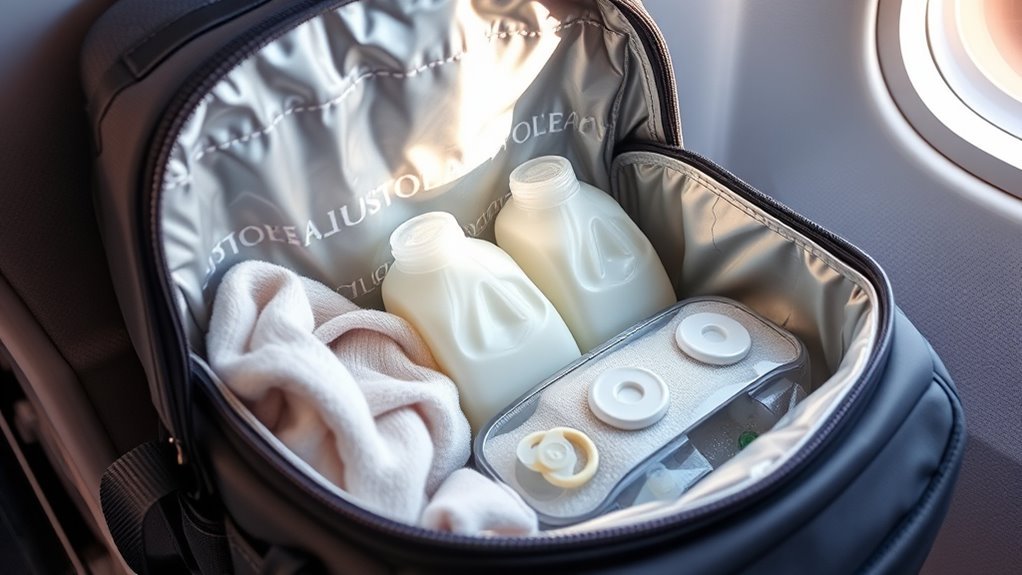
To keep breast milk cold in a diaper bag during travel, use an insulated bag or pocket with frozen ice packs, keep the milk in clean, labeled, leak-proof containers, pack it right at the center of the cooler, and open the bag as little as possible. Cool the milk before you pack it, and refrigerate or use it as soon as you arrive. Check current guidance from your pediatrician or a lactation consultant, and from the CDC, for storage times.
Plan Before You Leave
- Chill the milk in the refrigerator before you pack it, since warm milk makes the ice packs work harder.
- Freeze the ice packs, and chill the cooler bag, if you can.
- Portion milk into amounts that your baby will usually finish in one feed, to avoid waste.
- Label every container with the date and time that the milk was expressed.
- Bring a few extra containers, in case of a spill.
Choosing an Insulated Bag
Look for a bag with good insulation, a firm lining that you can wipe clean and a closure that stays shut. A bag made for the purpose is better than an ordinary pocket, though many diaper bags have an insulated section. Keep in mind that insulated pockets only slow warming. They do not keep things cold without ice packs. See how insulated diaper bag pockets work. Clean the bag after every trip, particularly after a spill. See how to clean insulated pockets after spills.
Ice Packs and Packing Order
- Put a frozen ice pack at the bottom of the cooler.
- Place the milk containers upright, and pack them tightly, so that they do not shift.
- Put another ice pack on top, and on the sides, if there is room, so that the milk is surrounded by cold.
- Fill any gaps with a small towel, so that the air space is small.
- Keep the cooler bag out of the sun, and away from hot surfaces.
Several smaller ice packs often work better than one large one. Choose packs that do not leak, and wipe condensation from the outside before you put the cooler in your diaper bag. For more about the diaper bag layout, see how to organize a diaper bag.
Storage Times
Storage advice differs a little between sources, and it depends on whether the milk is freshly expressed or thawed. The CDC gives guidance on how long milk can be kept at room temperature, in a cooler with ice packs, in a refrigerator and in a freezer. As a general rule, freshly expressed milk stays safe for only a few hours at room temperature, and it keeps longer in a cooler with ice packs. Thawed milk has shorter limits. Check the current CDC pages, linked below, and ask your pediatrician for advice specific to your baby, particularly if your baby is premature or has a health condition.
Sources: CDC: breast milk storage questions and answers; TSA: breast milk, formula and juice.
Packing Containers Safely
- Use clean containers that are made for storing milk, with tight lids.
- Do not fill containers to the top, since milk expands when frozen.
- Keep a spare lid or a few spare bags in the bag.
- Put the containers in a sealed bag, in case of a leak.
- Wash your hands before you handle milk.
On Planes, in Cars and on Public Transport
- Flying: in the United States, the TSA allows breast milk in reasonable quantities through the security checkpoint, and you should tell the officer when you arrive. Rules differ between countries and airlines, so check ahead. See diaper bag airport security rules for milk and baby food and can you bring a diaper bag on a plane.
- Driving: keep the cooler inside the car, out of the sun, and not in the trunk in hot weather. Never leave a child or milk in a parked car.
- On foot or by public transport: keep the cooler bag close, and out of the heat.
What to Do if the Milk Gets Warm
- Check how long the milk has been out of the cooler, and how warm it was.
- If you are unsure, follow current storage guidance, and ask your pediatrician.
- Smell and look at the milk. A sour smell is a sign that it has spoiled. Milk can separate into layers, which is normal, and it does not mean that it is bad.
- When in doubt, throw it out.
Seasonal Notes
In hot weather, the cooler works harder. Use more ice packs, keep the bag in shade and check it more often. In cold weather, take care that milk does not freeze, unless you intend to freeze it. See seasonal diaper bag packing tips.
Frequently Asked Questions
How Can I Keep Breast Milk Cold While Traveling?
Use an insulated bag with frozen ice packs, pack the milk in sealed, labeled containers and keep the bag closed and out of the heat.
Does TSA Allow Ice Packs for Breast Milk?
In the United States, the TSA generally allows ice packs and breast milk for a child. Check the TSA website for current rules, and tell the officer at the checkpoint.
How Long Can Breast Milk Stay Out of the Fridge?
Only for a limited time, which depends on the temperature. Check the current CDC guidance, and your pediatrician advice.
Conclusion
With a good insulated bag, frozen ice packs and clearly labeled containers, you can travel with breast milk safely. Chill the milk first, keep the bag shut and cool, check storage times with reliable sources and refrigerate the milk as soon as you arrive.