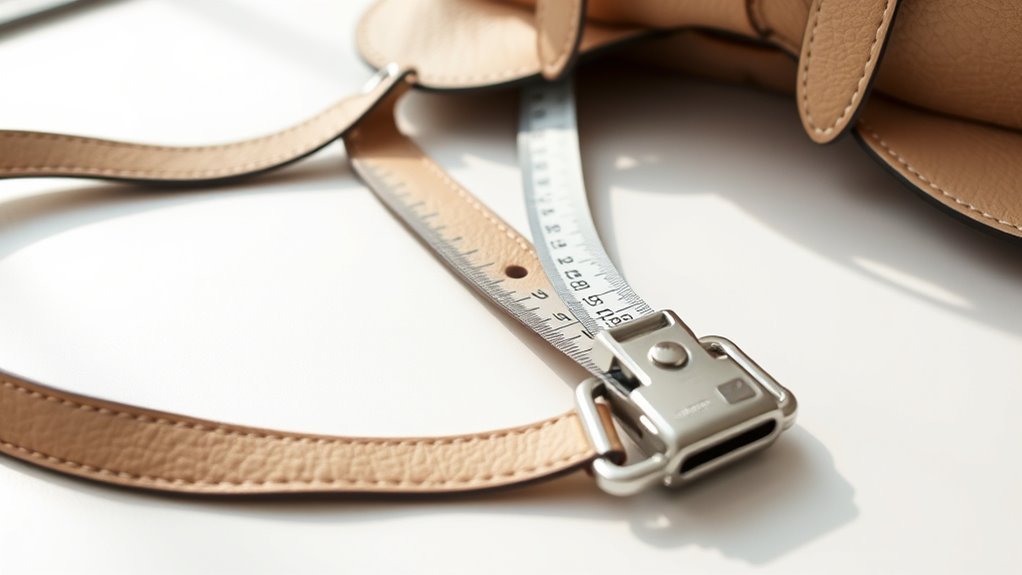
To measure handbag strap width at a clip or buckle, lay the strap flat and measure straight across it at the exact point where it passes through the hardware. Then measure the inside width of the clip eye or buckle frame, which is the opening the strap sits in. The two numbers should match, or the opening should be about 1 mm wider. Use a rigid ruler or a caliper and write the result in millimeters.
Key Components of Handbag Straps and Their Importance
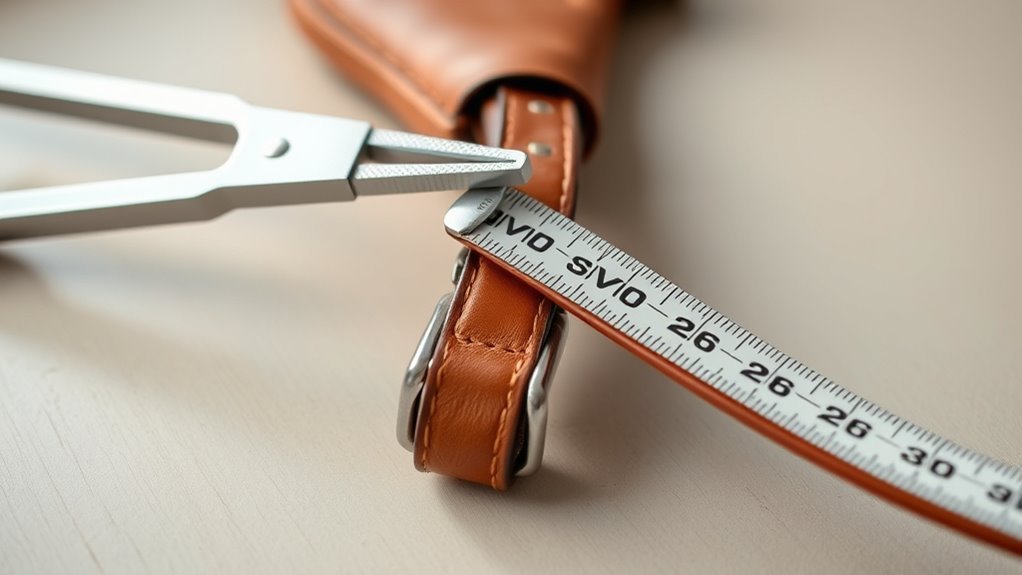
Strap hardware is sized by its inside width, which is the width of the strap it accepts. A 25 mm buckle takes a 25 mm strap. Common sizes are 13, 16, 20, 25, 32, and 38 mm, which match the inch sizes of 1/2, 5/8, 3/4, 1, 1 1/4, and 1 1/2. If the strap is too wide, it will not go through. If it is too narrow, it slides from side to side and wears at the edges.
Width affects looks too. A strap that fills its hardware looks neat and intended. A thin strap in a wide buckle looks like a mismatched replacement.
Tools You Need for Accurate Measurement
You need very little. A rigid ruler with millimeter marks does the job. A digital caliper is more precise and makes it easy to measure the inside of small hardware.
A soft tape measure is harder to hold straight on something this small, so use it only if you have nothing else.
Work in millimeters. Hardware is sold in metric sizes or inch fractions, and millimeters convert cleanly to both. Measure twice to confirm.
Write each number down with a note of where you took it, such as strap end, buckle, or clip.
Step-by-Step Guide to Measuring Strap Width
With the tools ready, measure the strap first and the hardware second.
Measure the strap where it meets the hardware, not in the middle of its length. Many straps are narrower or folded at the ends.
This matters most when you are buying a replacement strap or new hardware online, where you cannot test the fit.
Tools Needed For Measurement
Here is a quick summary of what each tool is for.
Lay the strap flat and untwisted. Place the ruler straight across it, edge to edge, at the point that sits inside the clip or buckle. Measure both ends of the strap, since they can differ. The table lists the tools.
| Tool | Purpose |
|---|---|
| Rigid Ruler | For standard width measurements |
| Digital Caliper | For precise measurements in mm |
| Notebook | To record measurements for clarity |
| Pen | To jot down any additional notes |
Measuring Clip Width
Most clips have two parts: a hook that snaps onto the bag, and an eye or loop that the strap folds through. The size of the clip is the inside width of that eye. Measure it straight across, from inner edge to inner edge.
Follow these steps for measurement accuracy:
- Use a ruler or caliper to measure the inner width of the clip. This dimension directly impacts strap compatibility.
- Record the measurement in millimeters (mm) for precision, as most clips are sized accordingly.
- If the strap falls between hardware sizes, choose the next size up. A strap cannot pass through an opening narrower than itself.
Compare the eye width with the strap width before you buy. Also check the hook end. Its opening has to fit over the ring on your bag.
Measuring Buckle Width
A buckle is sized the same way, by the inside width of its frame. Lay the buckle flat and measure between the inner edges of the two side bars. On a buckle with a prong, measure along the center bar that the strap wraps around. Check the strap thickness too. A thick leather strap may not fit through a slim slide buckle, even when the width is right. Measure twice.
| Step | Action |
|---|---|
| 1 | Place buckle on a flat surface |
| 2 | Measure inner edges with ruler/caliper |
| 3 | Note prong base width if applicable |
| 4 | Record and verify your measurement |
Avoid These Common Measurement Mistakes
Most wrong orders come from a few simple errors.
Here are the ones to watch for:
- Measure at the Clips or Buckles: Always measure at the exact point of the clips or buckles. The width can differ from the strap’s body, leading to errors.
- Use a Rigid Tool: Opt for a rigid ruler or caliper instead of a flexible measuring tape. Flexible tools can bend and create inaccuracies in your measurements.
- Double-Check Both Sides: Measure both sides of the clip or buckle, as they mightn’t be uniform.
Write the result in millimeters, and note the nearest inch size as well if the seller uses inches.
If the strap falls between two hardware sizes, pick the larger hardware. A 23 mm strap fits a 25 mm buckle but not a 20 mm one. If you are buying a strap for hardware you already have, pick a strap that matches the opening or is 1 to 2 mm narrower.
Take a photo of the ruler against the part, so you can check it later.
Measuring Tapered Straps
Some straps taper. They are wide in the middle for comfort and narrow at the ends to fit small hardware. On these, the end width is the number that matters for clips and buckles.
Measure right at the end, where the strap folds around the clip or enters the buckle.
Note the widest point as well. You will need it if you are choosing a shoulder pad or matching the strap to another one.
Key Measurement Techniques
For a tapered strap, take these measurements:
- Lay the strap flat: This confirms you get an accurate read on the width at both ends.
- Measure at both points: Record the width at the widest and narrowest areas to capture the size variance affecting strap compatibility.
- Use consistent intervals: If your strap has a gradual taper, measure at regular intervals to reflect width changes accurately.
Label each number, for example end 20 mm and middle 38 mm.
Match the end width to the hardware. Ignore the middle width for that purpose.
Importance of Accurate Sizing
A small error matters here, because hardware sizes are only a few millimeters apart.
Measure the part of the strap that will sit in the hardware. On a tapered strap that is the narrow end, not the widest point. A caliper helps if the strap is thick or padded.
Most handbag straps are between 13 and 38 mm wide. Check your number against the size the seller lists, and ask whether it means the inside width.
Getting it right the first time saves a return and protects the bag from a strap that twists or slips.
Adjustments for Tapered Straps
A few extra checks help with tapered and folded straps.
Go through them before you order parts:
- Identify the Taper Points: Measure the width at both clips and buckles to confirm a proper fit.
- Use a Rigid Measuring Tool: A ruler or caliper will give you precise measurements at the strap ends.
- Record Multiple Measurements: Capture dimensions at both the start and end of the taper, including any seams or stitching.
How to Check if Your Strap Fits the Clips and Buckles?
Before you rely on a new strap or clip, check the fit by hand.
Slide the strap end through the clip eye or buckle. It should pass through flat, without bunching, and fill most of the opening. A gap of about 1 mm on each side is fine.
If the strap has to be squeezed or folded to get through, the hardware is too small. It will crease the edges and wear the strap quickly. If the strap slides sideways, the hardware is too large.
Check the listed size of any part you buy, and confirm that the seller means the inside width. Outside width is always larger and will mislead you.
Last, clip the strap to the bag and give it a firm tug. The hook should close fully around the ring.
Factors to Consider When Choosing Strap Width for Your Handbag
If you are choosing a new strap, width is partly comfort and partly looks. Keep these points in mind:
Consider these factors:
- Bag Weight: For heavier bags, opt for wider straps (around 1.5 inches) for added comfort. Lighter, formal bags can work well with narrower options.
- Compatibility: Verify the clips and buckles can accommodate your chosen strap width. This prevents damage and guarantees secure attachment.
- Material Evaluation: Thicker materials need wider clips for durability and aesthetic balance, so think about how the strap’s material interacts with its width.
Frequently Asked Questions
How Do You Measure Purse Strap Length?
Lay the strap flat and measure from one end to the other, including the clips. For an adjustable strap, measure at the shortest and longest settings. Strap drop is different. It is the vertical distance from the top of the strap to the top of the bag.
How Wide Is a Strap?
Most handbag straps are about 13 to 38 mm wide, or 1/2 to 1 1/2 inches. Thin evening straps and chains sit at the low end. Wide crossbody and guitar-style straps can reach 50 mm, or 2 inches.
Conclusion
Measure the strap where it meets the hardware, measure the inside width of the clip or buckle, and make sure the two match. Work in millimeters, measure twice, and size up the hardware if the strap falls between sizes.